Essential Roles in Agile Software Development
- Ron Smith
- 4 hours ago
- 16 min read
Think of a high-performance pit crew during a race. Every person has a specific, critical job, yet they all move in perfect sync to hit a single goal with mind-bending speed. That's the essence of a great Agile team. It’s not just about running a process; it's about putting the right people in the right roles and empowering them to work together without friction.
This isn’t some abstract theory. It’s a fundamental shift away from siloed departments toward a single, unified team focused on one thing: shipping a fantastic product.
The Blueprint for High-Performing Agile Teams
The massive move to this model isn’t a coincidence. The numbers speak for themselves. Agile adoption among developers has exploded from 37% to 86% over the last five years. Why? Because it delivers.
Agile now sits at the core of 61% of companies' digital transformation efforts, with 64% of them saying it dramatically improved their ability to handle shifting priorities. In a world where change is the only constant, that's a massive competitive edge.
The Purpose Behind The Roles
At its core, the Agile framework is built for speed and adaptability. The roles are distinct for a reason—to make sure every part of the product creation process is covered without the classic bottlenecks that plague traditional project management.
It breaks down like this:
Vision and Direction: Someone has to own the what and the why. That's the Product Owner.
Process and Facilitation: The team needs a coach—someone to keep them true to Agile principles and clear the roadblocks. That's the Scrum Master.
Execution and Delivery: You need a dedicated crew with the skills and autonomy to actually build the thing. That's the Development Team.
Think of it as a system of checks and balances. The Product Owner ensures the team builds the right thing. The Development Team ensures they build it right. And the Scrum Master ensures they can do it all in the right way.
To give you a clearer picture, let's break down these core roles into a simple table.
Core Agile Roles at a Glance
This table offers a quick summary of the three fundamental roles you'll find in nearly every Scrum team and what they're ultimately responsible for.
Role | Primary Focus (The 'Why') | Key Responsibilities (The 'How') |
|---|---|---|
Product Owner | Maximizing product value and ROI | Defines the product vision, manages and prioritizes the product backlog, represents stakeholder interests. |
Scrum Master | Protecting the team and the process | Facilitates Agile ceremonies, removes impediments, coaches the team on Agile principles, ensures the framework is followed. |
Development Team | Building a high-quality, shippable product | Designs, builds, and tests product increments; self-organizes to complete sprint work; commits to the sprint goal. |
Each role is a crucial piece of the puzzle. When they work in harmony, they create a powerful, self-sufficient unit that can deliver value consistently.
This guide will dive deep into each of these essential roles in agile software development, explaining how they interact and what makes them tick. Getting this structure right is the first step toward building a team that doesn't just survive, but truly thrives.
For a closer look at improving your team’s performance, check out these Agile Methodology Best Practices. You can also explore our detailed guide on the modern agile team structure for more context on how these pieces fit together.
Understanding the Core Agile Trio
Sure, Agile can balloon to include all sorts of specialized roles, but the whole system rests on a foundational trio. These three functions—the Product Owner, the Scrum Master, and the Development Team—have to work in a tight, symbiotic loop. If you don't get this core dynamic right, nothing else matters.
Think of it like building a custom race car. You need a visionary who knows exactly what that car must do to win the race. You need a master mechanic who keeps the crew working efficiently without getting sidetracked. And you need the skilled crew who actually builds the thing. Each role is distinct but completely codependent. Get it right, and you’ve built a powerful engine for delivery.
The Product Owner: The Visionary
The Product Owner (PO) is the strategic heart of the project. They are the single, authoritative voice of the customer, the business, and any other stakeholder with skin in the game. Their entire job is to define what the team will build and, more importantly, why it matters, making sure every single feature delivers maximum value.
This isn’t your traditional project manager. The PO owns the product backlog—a living, breathing, prioritized list of features, fixes, and requirements. They spend their days neck-deep in market research, talking to stakeholders, and translating all those insights into clear, actionable user stories the team can actually build.
A great Product Owner doesn't just manage a to-do list; they craft a compelling vision for the product. They have to be decisive, know their domain inside and out, and be empowered by the organization to make the final call on product direction. This clarity is what stops the team from getting pulled in a dozen different directions.
The Scrum Master: The Coach
While the Product Owner is obsessed with the product, the Scrum Master is obsessed with the team and the process. They're part facilitator, part coach, and part protector of the Agile framework. Their goal is to create an environment where the team can be as effective and self-sufficient as possible.
Don't make the common mistake of thinking the Scrum Master is the "team boss." They're not. They're a servant-leader who exists to remove obstacles—or impediments—that are slowing the team down. That could be anything from a technical bottleneck to a bureaucratic process creating friction.
So, what does a Scrum Master actually do all day?
Facilitating Agile ceremonies like daily stand-ups, sprint planning, and retrospectives to make sure they're productive, not just meetings for the sake of meetings.
Coaching the team on Agile principles, helping them learn to self-organize and continuously fine-tune their workflow.
Shielding the team from outside distractions so they can stay laser-focused on hitting their sprint goal.
Their success isn't measured by features shipped. It's measured by the health, morale, and ever-improving velocity of the team.
The Development Team: The Builders
The Development Team is made up of the cross-functional pros who get the work done. And I don't just mean coders. This team includes everyone needed to take a backlog item and turn it into a shippable piece of the product—designers, QA engineers, developers, you name it.
This group is self-organizing and holds collective responsibility for the quality and completion of their work. They pull items from the product backlog into a sprint, and they decide how to accomplish the work. The team commits to a sprint goal and has the autonomy to figure out the best way to hit it.
The synergy between these three roles is what makes Agile tick. The Product Owner sets the destination (the "what"), the Development Team builds the vehicle to get there (the "how"), and the Scrum Master keeps the road clear and the engine tuned.
This structure works so well that it's breaking out of IT. The traditional roles in agile software development have evolved, with engineering and R&D teams now being the fastest-growing adopters of Agile, making up 48% of practitioners as of 2025. That’s a huge shift. We're seeing this agility bleed into all sorts of business units, where roles like the Product Owner now account for 36% of all Agile practitioners. You can discover more insights about the spread of Agile roles across industries.
Assembling Your Extended Agile Team
The core trio—Product Owner, Scrum Master, and the Development Team—is a delivery powerhouse. But let's be honest, building modern software that people actually love takes more than just that.
Think of the core trio as the engine, chassis, and driver of a race car. It'll get you around the track. But to actually win, you need specialists tuning the aerodynamics, managing the tires, and mapping out race strategy. That’s your extended team.
These aren't just consultants you call in once a quarter. These roles in agile software development are deeply integrated specialists who turn a functional product into something that’s intuitive, rock-solid, and ready to scale. Getting them involved early saves you from costly rework down the line and makes sure you're building the right thing the right way.
The UX/UI Designer: The Voice Of The User
A UX/UI Designer is your team's direct line to the end-user. They live and breathe the user's experience, focused on making the product feel intuitive, simple, and even enjoyable. While the Product Owner is figuring out what the product needs to do, the UX/UI Designer is obsessed with how it should feel.
In a real Agile setup, designers don’t just lob static mockups over the fence. They’re in the trenches, usually working a sprint or two ahead of the developers. They’re busy with user research, wireframing, and building interactive prototypes. This “dual-track” approach means that by the time a feature is ready for a developer to touch, it’s already been poked, prodded, and validated by real users.
Their constant involvement makes user feedback a steady stream, not a last-minute surprise. It gives the team the power to pivot based on what people actually do, not what you think they'll do.
The QA Engineer: The Guardian Of Quality
In Agile, Quality Assurance (QA) isn't a tollbooth at the end of the road. It's a mindset that's baked into every single step. The QA Engineer is the champion of that mindset, making sure quality is everyone's job from day one.
Instead of waiting for a feature to be declared "done," Agile QA Engineers are collaborating with everyone from the very beginning.
During sprint planning, they're there, helping hash out acceptance criteria so everyone knows what "done" actually looks like and how to test it.
Throughout the sprint, they're working side-by-side with developers, testing small chunks of code as they’re written and automating everything they can.
Before the sprint wraps up, they’re the ones confirming that the work meets the "Definition of Done" and is genuinely ready to ship.
This approach catches bugs when they're small, cheap, and easy to fix. It stops them from snowballing into sprint-derailing disasters and turns quality from a final inspection into a shared responsibility.
An extended Agile team is like a surgical team. The surgeon (Development Team) is doing the critical work, but the anesthesiologist (QA) and surgical nurse (UX) are right there, constantly monitoring, adjusting, and providing vital support. The patient's success depends on all of them working in perfect sync.
The Solution Architect: The Technical Visionary
As your product grows, so does the complexity. A Solution Architect is the one looking at the big picture, providing the technical vision to ensure the product isn't just working today but will be scalable, secure, and maintainable years from now. They’re thinking about the long-term health of the system.
While the Development Team is heads-down on the "how" of this sprint's tickets, the Solution Architect is designing the technical runway for all the sprints to come. They're making the big calls on the tech stack, data architecture, and how all the different pieces of the puzzle will connect.
Their guidance ensures that even if you have multiple teams working on different parts of the product, everything will eventually fit together into a cohesive, robust whole. They stop you from making those short-term technical choices that pile up into massive technical debt later.
A lot of their responsibilities bleed into DevOps, a discipline all about bridging the gap between development and operations. If you want to go deeper on how these critical technical leadership roles work, you can learn more by mastering DevOps team roles and responsibilities. It’s essential knowledge for any company serious about scaling its tech.
How to Scale Agile Roles in Large Organizations
When a single Agile team is firing on all cylinders, it's a beautiful thing. But what happens when you’re trying to coordinate five, ten, or even fifty teams building one massive product? The very autonomy that makes a small team fast can quickly devolve into chaos at scale. This is where scaling frameworks come in, and they bring their own set of specialized roles.
We're seeing a huge shift toward integrating technical leadership directly into these scaled frameworks to wrangle that complexity. By 2025, the Scaled Agile Framework (SAFe) is on track to become the go-to approach for large enterprises. Its adoption has jumped from 37% in 2021 and is expected to hit 53% by 2025. That trend tells you everything you need to know: there's a massive demand for people who can bridge deep technical expertise with big-picture Agile leadership. You can read the full research on these scaling trends and what they mean for building a modern workforce.
The Agile Release Train and Its Conductors
To keep things from going off the rails, frameworks like SAFe introduce a new layer of roles designed to keep everyone pointing in the same direction. Think of a collection of Agile teams as an Agile Release Train (ART)—it's a team of teams, all chugging along the same track toward a common goal. But even the most powerful train needs someone conducting it and someone plotting the course.
Release Train Engineer (RTE): This is the head Scrum Master for the entire ART. Their job isn’t to micromanage but to facilitate the big, program-level events, coach the team leaders, and bulldoze any impediments that are too big for a single team to handle.
Product Manager: While a Product Owner is deep in the weeds with their team's backlog, the Product Manager owns the vision for the entire train. They're the ones defining and prioritizing the major features that make up the whole solution.
System Architect: This role provides the technical North Star. They're responsible for the "architectural runway," making sure the work coming from all the individual teams will actually fit together into a stable, coherent system down the line.
The diagram below shows how other key specialists, like UX designers and QA engineers, plug into this extended team structure, creating a system of checks and balances.
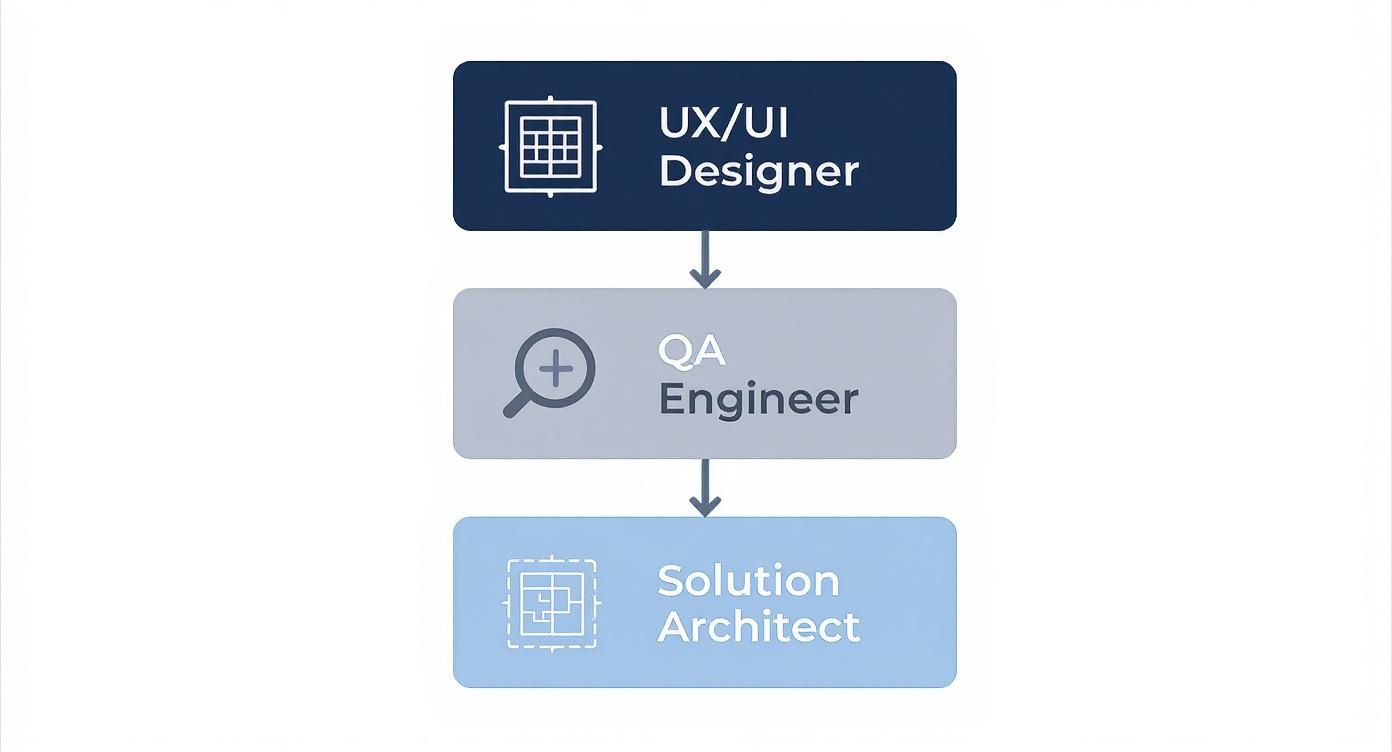
This shows that while developers are heads-down building, these other roles are providing the crucial guardrails—ensuring the user experience is solid, quality is high, and the technical strategy is sound.
Keeping Dozens of Teams Flying in Formation
Let's try an analogy. If one Agile team is a nimble fighter jet, the Release Train Engineer is the air traffic controller for the whole squadron. Each pilot has the autonomy to maneuver and hit their specific targets, but the RTE is watching the skies, making sure they don’t collide, are all heading for the same battlefield, and have a clear runway when it's time to land.
The RTE isn't a manager in the old-school sense; they are a servant-leader for the entire program. Their obsession is optimizing the flow of value through the ART and ensuring all the moving parts are perfectly synchronized.
This structure is how an organization gets the best of both worlds: the speed and empowerment of small teams, plus the alignment needed to deliver something massive and complex. It's a direct answer to emerging trends in workforce management, allowing companies to coordinate a global mix of contingent and full-time talent into one unified vision without being crushed by bureaucracy. The rise of these specific Agile roles isn't an accident—it's a clear signal that the industry is moving toward structured, scalable agility.
Building Your Team with Modern Workforce Solutions
Figuring out the right roles in agile software development is just the start. The real test is finding the people to fill those seats—that’s where your strategy either pays off or falls apart. Assembling a killer team isn't about collecting a bunch of individual rockstars; it's about building a cohesive unit that actually enjoys working together and getting better every day.
Sure, technical chops are table stakes. But the real difference-makers on an Agile team are the ones with killer soft skills. You need people with a natural curiosity, a genuine love for solving tough problems, and the ability to talk to other humans with clarity and empathy. These are the folks who don't just ship code—they build better products and a stronger culture while they're at it.
Evaluating Candidates for Key Agile Roles
When you're interviewing for a Product Owner, Scrum Master, or a senior dev, you have to go beyond the typical tech trivia. Your mission is to see how they think, how they collaborate, and how they handle themselves when things inevitably go sideways. Behavioral and situational questions are your best friends here.
For instance, try throwing these at them to see what’s really under the hood:
For a Product Owner: "Tell me about a time you had to tell a powerful stakeholder 'no.' How did you navigate that conversation, and what happened next?"
For a Scrum Master: "Walk me through how you'd deal with two developers who are clashing over a technical approach."
For a Developer: "Talk about a time your team totally missed a sprint goal. What did you take away from the retro, and what changed because of it?"
Questions like these force them to pull from real-life battle scars, telling you way more about whether they'll thrive in an Agile setup than any coding test ever could.
The Rise of Modern Staff Augmentation
The old choice between hiring full-time or grabbing a temporary contractor is getting stale. A new kind of staff augmentation is taking over, built for speed, cost-efficiency, and access to a global talent pool. It’s not about finding individual freelancers anymore; it’s about plugging in pre-built, cohesive teams that can integrate fast and start delivering value from day one. This is a crucial workforce management trend for any company looking to scale.
This model is a direct response to how modern work gets done. Instead of burning months trying to build a team from scratch, you can tap into ready-made "squads" that already have the technical skills and collaborative rhythm to hit the ground running. It’s simply the most affordable and efficient way to get your hands on world-class global engineering talent without all the baggage of traditional hiring.
The new way of thinking about contingent labor isn’t about just filling a seat for a few months. It's about strategically injecting a fully-functional, high-performing team into your org to crush a key project or fill a critical, long-term skills gap at the most affordable cost.
Deciding Your Hiring Strategy
So, do you build an in-house team or go with modern staff augmentation? The right answer depends entirely on your goals, your timeline, and your budget. Neither one is a silver bullet; you just need to know when to use which tool. For a lot of startups and midsize companies, a hybrid approach often gives them the best of both worlds.
Let's break down when each approach makes the most sense.
Hiring Strategy: In-House vs. Staff Augmentation
Consideration | Best for In-House Hiring | Best for Staff Augmentation |
|---|---|---|
Project Duration | Best for core, long-term, and permanent business functions where deep institutional knowledge is critical. | Ideal for projects with defined timelines, specialized skill requirements, or the need to scale up or down quickly. |
Speed to Market | Slower, as it involves a lengthy process of recruiting, interviewing, hiring, and onboarding individual team members. | Significantly faster, allowing you to onboard a pre-vetted, cohesive team in weeks rather than months. |
Cost and Overhead | Higher initial and ongoing costs, including salaries, benefits, office space, and administrative overhead. | More affordable due to competitive global labor rates and reduced overhead; you pay for the service, not the full cost of employment. |
Access to Talent | Limited to the talent available in your local market or those willing to relocate. | Provides access to a global talent pool, allowing you to find highly specialized skills that may not be available locally. |
Flexibility | Less flexible, as scaling the team up or down involves complex hiring or layoff processes. | Highly flexible, enabling you to adjust team size and composition based on evolving project needs without long-term commitments. |
At the end of the day, using a modern staff augmentation partner like Shorepod is a powerful way to supercharge your existing team. It lets you keep a core in-house crew focused on your main business goals while using specialized, on-demand global teams to hit the accelerator on growth, tackle new projects, and leave your competition in the dust.
The Future of Agile Teams and AI Integration
The roles we've just broken down aren't set in stone. They're constantly evolving, and the biggest catalyst for change right now is Artificial Intelligence. AI isn't coming to replace your team; it's here to give them superpowers. This advancement in technology is a key emerging trend impacting workforce management and contingent labor.
This isn't some far-off-in-the-future prediction. It’s already happening.
For a Product Owner, AI tools can chew through thousands of customer feedback tickets, forum posts, and support logs to surface real trends. Instead of spending days sifting through data, the PO can focus on the big-picture strategy, armed with insights they couldn't possibly have found on their own.
And for Scrum Masters? Think predictive analytics. AI can analyze team velocity, task dependencies, and historical sprint data to flag potential roadblocks before they grind everything to a halt. It shifts the role from a reactive firefighter to a proactive guide, keeping the entire workflow smooth.
AI Is Changing How We Build Teams
This isn't just about making existing roles more efficient. AI is fundamentally changing how we find and manage talent, especially when it comes to contingent labor.
Smart algorithms can now scan the entire global talent pool, vetting engineers with specialized skills at a speed and accuracy that's simply impossible for a human recruiter. It's creating a whole new category of staff augmentation—one that's faster, more precise, and frankly, more affordable.
Forget the months-long traditional hiring cycle. Companies can now tap into a pre-vetted reservoir of global engineers and assemble a world-class team in days. This model gives you access to top-tier global talent without the overhead and long-term commitment of direct hires.
The real future of building Agile teams is using AI to find and manage global talent. It's about constructing smarter, more adaptable, and cost-effective teams that can take on any challenge you throw at them.
What This Means for Agile Roles
So what happens when technology handles the grunt work? The so-called "soft skills" become the hard skills. The roles in agile software development are shifting away from task management and toward human-centric strengths.
Emotional intelligence, creative problem-solving, and deep strategic thinking—that's what will separate the great teams from the good ones. The focus is no longer on managing tickets, but on leading collaborative innovation.
Bringing tools like Microsoft AI Copilot into the mix only accelerates this. They automate routine coding and documentation, freeing up developers to focus on complex problem-solving. But this introduces a new challenge: managing software development in the AI era.
The winning teams will be the ones who master this new dynamic—using technology to empower human creativity, not replace it.
A Few Common Questions About Agile Roles
When teams start adopting Agile, a few practical questions always seem to pop up, especially when people are trying to figure out how their old roles fit into this new world. Let's clear up some of the most common ones.
Can One Person Juggle Multiple Agile Roles?
It's a tempting thought, especially for a lean startup trying to save money: "Why not just have one person be both the Product Owner and the Scrum Master?"
I'll be blunt: it’s a terrible idea. These roles are designed with a built-in, healthy tension. The PO’s job is to push for maximum value, which often means asking for more, faster. The Scrum Master’s job is to protect the team’s health, process, and sustainable pace. They're the ones who say, "Hold on, we need to slow down to maintain quality."
When you merge these two, one side always loses, and it's almost always the process. The drive to ship features steamrolls everything else, leading straight to burnout, technical debt, and shoddy work. Keeping them separate isn't about bureaucracy; it's about maintaining the checks and balances that make Agile work in the first place.
Do These Roles Even Exist in Kanban?
Not officially. If you read the Kanban guide, you won't find job titles like "Product Owner" or "Scrum Master." Kanban is much more flexible and less prescriptive by nature.
But here’s the thing: the functions are still absolutely essential. Every team, Kanban or not, needs someone who owns the "what" and "why"—prioritizing work and defining value. That's your Product Owner function. And every team needs someone focused on flow, unblocking issues, and helping everyone improve the process. That's your Scrum Master function.
The titles might be different—maybe you have a "Flow Master" or a "Service Delivery Manager"—or the responsibilities might be shared across the team. But the needs don't just disappear because you're using a different framework.
Where Does a Traditional Project Manager Fit Into All This?
In a textbook Scrum setup, the traditional Project Manager role is gone. Its duties are deliberately split between the Product Owner (managing scope and priorities), the Scrum Master (managing process and impediments), and the Developers themselves (managing their own work).
Now, let's get back to reality. In most large companies or hybrid environments, you'll still find Project Managers. Their role just looks different. They tend to operate outside the team's day-to-day sprint cycle, handling things like budget approvals, high-level reporting to executives, and coordinating dependencies across multiple Agile teams.
The key is that they support the team without meddling in its self-organization. It’s a fine line to walk, but a crucial one to protect the team's autonomy. And with the rise of AI and smarter workforce management tools, the way we handle those cross-team dependencies is changing fast, which will only continue to evolve these roles.
Ready to build your high-performing global team? Shorepod offers a new kind of staff augmentation, giving you access to pre-vetted, cohesive engineering teams at the most affordable cost. Stop searching and start building. Discover your perfect team today.