What is technical leadership? Key traits for tech teams
- Ron Smith
- Oct 23
- 13 min read
Technical leadership isn’t just about being the best coder on the team. It’s about being the team’s technical compass—blending deep engineering expertise with the vision to guide everyone toward building the right product, the right way. It’s a role that ensures every decision, from a single line of code to the entire system architecture, aligns with both technical excellence and the company's bottom line.
The Modern Technical Leader Is No Longer Optional
Think of a technical leader as the master architect of a skyscraper. They don’t just lay bricks; they own the blueprint, guarantee the foundation is rock-solid, and guide the entire crew to build a structure that will stand for decades. This is about moving past simple task management and shaping how a team solves complex problems.
And this role has never been more critical. As the global tech market barrels toward a projected $5.8 trillion, the pressure is on. With 72% of CTOs laser-focused on cloud-native application development, leadership is shifting toward building agile, scalable platforms that can keep up. You can dig deeper into these technology growth trends and their impact here.
What Sets Technical Leaders Apart
Unlike a traditional manager who might be obsessed with timelines and budgets, a technical leader lives and breathes the technological execution. Their focus is completely different, centered on the health, quality, and future of the technology itself.
They Mentor and Empower: A huge part of their mission is to elevate the skills of their team, creating an environment where continuous learning isn't just encouraged—it's expected.
They Provide Architectural Guidance: They are the ones making the tough calls on system design, frameworks, and tools to kill technical debt before it starts and ensure the platform is built for the long haul.
They Bridge Communication Gaps: They have the unique ability to translate dense, technical concepts into clear business impact for stakeholders, making sure everyone from the C-suite to the junior devs is on the same page.
A great technical leader doesn’t just build products; they build the team that builds the products. Their success isn't measured by their own code commits, but by the collective output and skill growth of their entire team.
As workforce management evolves—with emerging trends like AI and contingent labor becoming the norm—the technical leader becomes the glue holding it all together. They are essential for guiding globally distributed teams and making sure advancements in technology are integrated smartly, not just for the sake of trends.
This often overlaps with the duties of an engineering manager. Understanding the key responsibilities of an engineering manager gives you a clearer picture of how these two powerhouse roles work together to drive real results.
Technical Leader vs Traditional Manager At A Glance
To put it plainly, these roles operate on different wavelengths. Here’s a quick breakdown of where their primary focus lies.
Focus Area | Technical Leader | Traditional Manager |
|---|---|---|
Primary Goal | Technical excellence & quality | Project delivery & budget |
Key Metric | System health, scalability, team skill | On-time, on-budget completion |
Daily Focus | Code reviews, architecture, mentorship | Resource allocation, timelines, reporting |
Team Interaction | Hands-on pairing, coaching, design sessions | Status updates, roadblock removal |
While a traditional manager asks, "Are we on schedule?", the technical leader is asking, "Did we build it right, and can it scale for the future?" Both questions are vital, but they come from completely different perspectives. A strong organization needs both to truly succeed.
Unpacking the Core Responsibilities of a Tech Lead
Let's move past the abstract and get into what a tech lead actually does day-to-day. It’s a lot more than just being a senior engineer with a fancy title. A great tech lead is the strategic linchpin holding everything together—making sure the team’s technical work is solid, coherent, and actually driving the business forward.
Their role is constantly shifting. One moment they’re deep in the code, the next they’re whiteboarding high-level architecture, and an hour later they’re mentoring a junior developer.
This infographic really nails the balancing act, showing how the role blends technical depth, team direction, and business alignment.
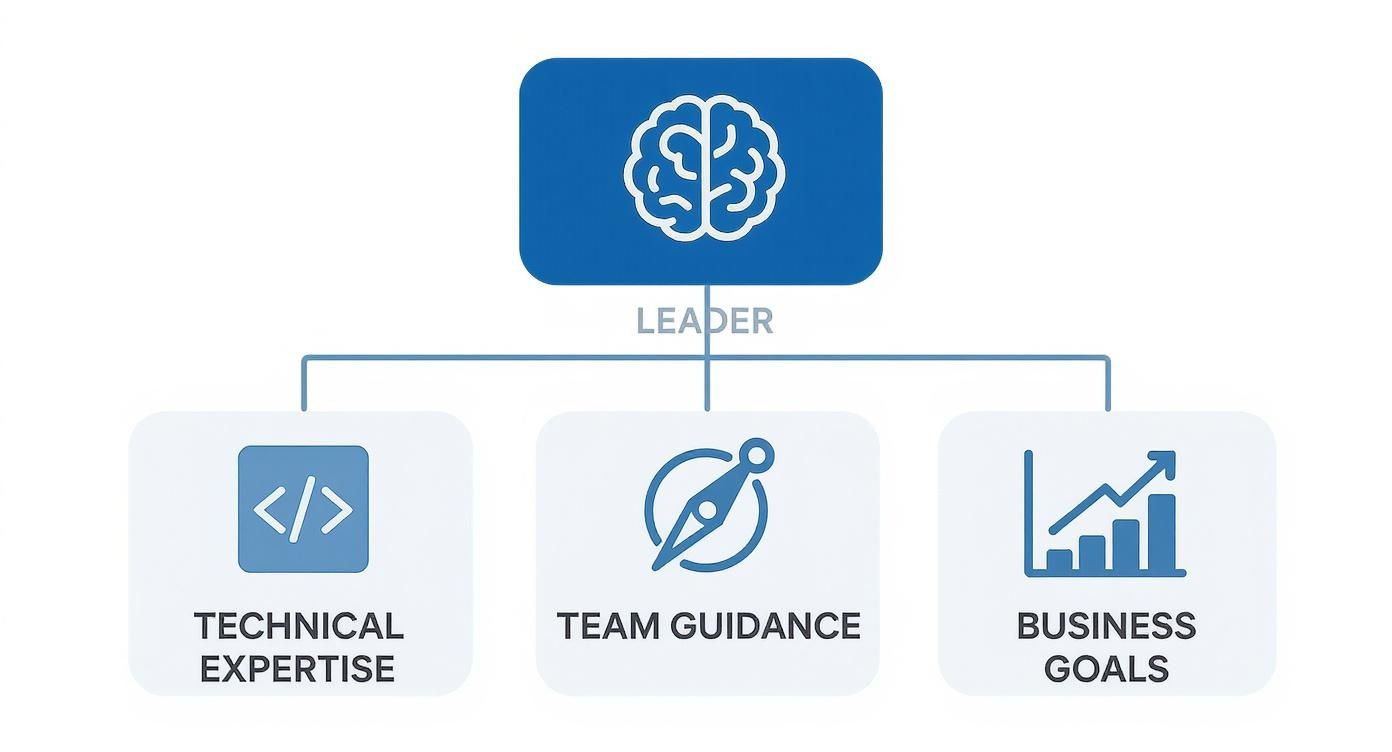
Look closely at the visual. It’s not just about coding chops. The leader's strategic thinking is propped up by three equal pillars. It’s a powerful reminder that elite technical skills alone don't make a leader. You have to fuse that expertise with clear team guidance and a relentless focus on business outcomes.
Establishing the Technical Vision
First and foremost, a tech lead owns the team's technical vision. This means making the tough calls on architecture, frameworks, and coding standards. They're not just building for today; they're laying a foundation that's scalable and maintainable years down the road.
For instance, a tech lead might be the one to champion a shift to a microservices architecture. They'll be the one explaining to engineers and product owners how breaking down a monolith will speed up deployments and make the whole system less fragile. This kind of foresight stops technical debt from piling up and ensures the team is building on solid ground.
And this responsibility is only getting bigger. We’re seeing a massive shift where tech leadership now influences the entire organization, well beyond the old IT department walls. With 91% of global tech decision-makers planning to boost IT spending, tech leads are now overseeing everything from risk management and cybersecurity to regulatory compliance. They’re steering AI adoption and managing complex tech partnerships, proving they are true catalysts for innovation. You can get a deeper look at the future trends influencing technology leadership here.
Mentoring and Empowering the Team
The best tech leads are force multipliers. They don’t just hoard the hardest problems for themselves—they make every single engineer on their team better.
This isn't an accident. It happens through deliberate actions:
Thoughtful code reviews that teach core principles, not just nitpick syntax.
Pair programming with junior devs to pass on institutional knowledge and build their confidence.
Running blameless post-mortems after an outage, turning a stressful failure into a powerful learning moment for everyone.
The true measure of a technical leader's success is not their individual contribution, but the growth and autonomy of their team. They create an environment where engineers feel empowered to take ownership and make sound technical decisions.
Bridging Technical and Business Worlds
Finally, a tech lead is a translator. They stand at the crucial intersection of the engineering team and the rest of the business, tasked with explaining complex technical ideas in a way that non-technical people can actually grasp.
This might mean explaining the business risk of launching a feature with a mountain of technical debt to a product manager. Or it could be justifying the need for a two-week sprint dedicated to infrastructure upgrades to the C-suite.
By closing this communication gap, they ensure the code being written is always tied directly to strategic business goals. That’s what makes them completely indispensable in any organization that wants to win.
The Essential Skills Every Technical Leader Needs
Let's get one thing straight: great technical leadership isn't just about being the best coder on the team. That’s a common misconception. It's really about blending deep technical credibility with the kind of interpersonal skills that make people want to follow you.
It’s the crucial difference between just shipping a feature and building a resilient, high-performing team that can tackle anything you throw at it.

On the technical side, mastery is the price of admission. But we're not talking about being the lone genius who knows every line of code. It's about a profound grasp of architectural design, a knack for systems thinking, and keeping an eye on what’s next with advancements in technology like AI and cloud-native development.
A leader's technical acumen is the bedrock of their authority. It’s what lets them guide architectural debates, intelligently challenge assumptions in a code review, and earn the genuine respect of their engineers. Without it, you're just a manager. With it, you're a leader.
Hard Skills: The Foundation of Credibility
Certain technical skills are non-negotiable. They’re what allow a leader to confidently steer the ship and make sure the team is building solutions that are robust, scalable, and built for the future, not just for today.
Think of it this way: anyone can follow a map, but a true leader can draw the map.
Here's a breakdown of the skills that build that kind of trust and credibility.
Skill Category | Essential Skills | Example Application |
|---|---|---|
Technical Acumen | Architectural Design & Systems Thinking | Guiding the team to design a microservices architecture that can scale from 1,000 to 1 million users without a complete rewrite. |
Strategic Vision | Technological Foresight & Trend Analysis | Identifying the rise of AI-powered development tools and leading a proof-of-concept to reduce boilerplate code generation by 30%. |
Execution | Code Quality & Best Practices | Stepping into a pull request to help a junior engineer refactor complex logic, improving performance and maintainability. |
Problem-Solving | Debugging & Root Cause Analysis | Leading a post-mortem for a production outage, not to assign blame, but to identify the systemic failure and implement preventative measures. |
These hard skills aren't just for show. They're the tools a leader uses every day to make sound judgments, unblock their team, and ensure the technical direction is solid.
Soft Skills: The Engine of Influence
Here’s the thing, though: technical prowess gets you a seat at the table, but it won't make anyone listen to you.
The ability to communicate clearly, empathize with your team, and negotiate with stakeholders is what turns a skilled engineer into an influential leader. These skills are the bridge between a technical vision and a team that's fired up to build it. And they're more critical than ever, especially when managing contingent labor.
The global market for leadership development is set to skyrocket from $89.54 billion to $238.5 billion by 2035. That's not just a random stat. It's a massive signal that companies know these "soft" skills are what they desperately need to navigate a complex digital world. A 41% growth in microlearning shows leaders are expected to be adaptable, constantly learning, and emotionally intelligent.
An effective technical leader doesn't just direct; they connect. They use their technical knowledge to build trust and their communication skills to build momentum, ensuring everyone is aligned and motivated.
This powerful combination is what unlocks a team's true potential. To get a better sense of how these interpersonal skills play out in the real world, check out this deep dive into leadership soft skills in action.
By developing both sides of this coin—from mentoring junior devs to taking ownership of messy cross-functional projects—aspiring leaders lay the foundation to guide their teams to incredible success.
Leading Technical Teams in a Distributed World
Leading a team you can’t see in person is a whole different ballgame. The old playbook just doesn’t work when your engineers are scattered across continents and time zones. To succeed, you have to be intentional—rethinking your strategy, your tools, and your entire mindset to keep a global team connected and moving as one.
This isn’t just a niche skill anymore; it’s a must-have. With emerging workforce management trends like contingent labor and global talent models becoming the norm, a technical leader’s ability to manage a distributed team is now a core strength. It’s all about building a single, cohesive unit, no matter how many miles separate you.
Championing Asynchronous Communication
The single biggest shift you have to make is embracing asynchronous communication. If you’re waiting for everyone to be online for a meeting, you’re creating bottlenecks and burning people out. Great leaders build systems that let work happen without needing everyone in the same virtual room at the same time.
It all comes down to prioritizing crystal-clear documentation and using tools that support that flow.
Beef Up Your Pull Requests: Encourage detailed descriptions that give the full story. A reviewer should understand the why behind the code without needing a live walkthrough.
Build a Central Knowledge Hub: Keep a single source of truth for everything—architectural decisions, coding standards, project goals. No more hunting through old chat logs.
Use AI to Cut Through the Noise: Advancements in technology like AI assistants in tools like Slack or Teams can summarize long threads, letting team members catch up in minutes, not hours.
This approach respects everyone’s time and creates a living history of decisions—something that’s priceless for both current team members and new hires. If you want to dive deeper into getting new folks up to speed, check out our guide on how to onboard remote employees.
Standardizing Environments to Reduce Friction
Next up: kill the "it works on my machine" problem once and for all. You can't just walk over to someone's desk to debug a wonky environment when your team is global. As a technical leader, you have to champion standardized development environments to keep things consistent.
A standardized development environment is the foundation of a productive distributed team. It removes pointless friction and allows engineers to focus on solving business problems, not fighting their local setup.
By using containerization tools or cloud-based IDEs, you make sure every engineer is working with an identical setup. This does more than just streamline onboarding for new staff—it makes collaboration smoother and deployments way more predictable. This is a perfect example of what technical leadership looks like in the real world: clearing technical hurdles so your team can fly.
How Global Talent Is Reshaping Tech Leadership
Let's be honest. The old way of hiring technical leaders is broken. It’s slow, it’s wildly expensive, and it’s completely out of sync with how fast-moving companies actually work. For decades, the playbook was the same: post a job, wait for applicants, endure months of interviews, and then pay a fortune to relocate the one person who finally said yes.
That entire process is a bottleneck. It puts critical projects on hold and shrinks your talent pool to whoever happens to live within a 50-mile radius.
But that outdated system is finally collapsing under its own weight. Smart organizations are waking up and embracing a much more agile approach. They’re no longer betting everything on a single, perfect permanent hire. Instead, they're building dynamic teams that blend full-time employees with on-demand, specialized global talent—a key trend in modern workforce management.
The Rise of Talent-as-a-Service
This fundamental shift has paved the way for a new model: Talent-as-a-Service (TaaS). Think of it like this: what if you had access to an elite, pre-vetted bench of the world's best technical leaders and engineers, ready to jump in whenever you need them? That’s TaaS. It’s the single most effective way to get world-class expertise without the overhead, risk, and long-term lock-in of a traditional hire.
A TaaS model gives modern businesses a serious edge:
Instantly Fill Leadership Gaps: You can bring an experienced technical leader on board in a matter of days, not months. No more stalled projects or rudderless teams.
Scale Engineering Teams Efficiently: Need to double your senior engineering capacity for a product launch? TaaS lets you add that firepower exactly when you need it and scale back down just as easily when the push is over.
Access Specialized Expertise: Get immediate access to leaders with deep, hard-to-find knowledge in fields like AI and machine learning, without getting into a bidding war in an overheated local market.
By tapping into a global talent network, companies transform technical leadership from a hiring bottleneck into a strategic advantage. It's about getting the right expertise at the right time, at the right cost.
This model is a direct answer to the realities of a distributed, digital-first world. It’s an acknowledgment that the best person to guide your team probably doesn't live down the street—they could be anywhere. The key is knowing how to integrate this flexible, contingent labor force, and that starts with a clear plan. For a deeper look at different approaches, you can explore our guide on building a global talent strategy with nearshore vs. offshore models. This is what modern technical leadership looks like: adaptable, global, and ruthlessly focused on results.
Finding Your Next Technical Leader with Shorepod
Knowing what makes a great technical leader is one thing. Actually finding one? That’s a whole different ball game.
The old way of hiring—slow, expensive, and tied to wherever your office is—just can’t keep up. It rarely delivers the kind of sharp, agile guidance that modern tech teams desperately need. This is exactly where you have to stop thinking about hiring and start thinking about a smarter way to manage your workforce.

This is where Shorepod’s Talent-as-a-Service (TaaS) model comes in. It’s a straight shot to a global network of proven technical experts, ready when you are. This isn't just about plugging a hole in the org chart; it's a strategic move to bring world-class leadership into your organization at a cost that makes sense.
Our experts are ready to jump in immediately to mentor your teams, steer complex projects, and push for real innovation. We take care of everything—vetting, interviewing, onboarding, payroll, and compliance—all managed through a single, seamless platform.
A New Model for Securing Talent
This isn't your typical staff augmentation. It delivers real advantages that you just can't get from a traditional hiring process. This is a new kind of staff augmentation, designed to level up your team’s entire capability.
Remarkable Cost-Effectiveness: Why pay inflated local market rates? We offer global talent at the most affordable cost, giving you access to top-tier technical leaders without breaking the bank.
Rapid Talent Deployment: We can get an experienced leader in place in days, not months. Your projects keep moving, and your teams never lose their guide.
On-Demand Expertise: Need someone who lives and breathes AI or distributed systems? Get that specific knowledge right when you need it, without the burden of a long-term salary.
Shorepod delivers the strategic technical guidance your organization needs to compete and win. We connect you with leaders who don’t just understand what technical leadership is—they live and breathe it at the highest level.
To get the most out of this approach, a dedicated talent management system software can be a game-changer. By shifting to a flexible, global model, you’re not just hiring someone; you’re securing the kind of world-class leadership that might have seemed out of reach, giving your teams the support they need to truly succeed.
A Few Common Questions About Technical Leadership
Let’s be honest, the lines around technical leadership can get blurry, especially with remote teams and new tech popping up every week. Here are some straight answers to the questions that come up most often.
Does a Tech Lead Need to Be the Best Coder on the Team?
Not even close. And frankly, they shouldn't be.
While a tech lead needs to be technically sharp to earn respect and guide decisions, their real job isn’t to be the #1 coder. It’s to be a multiplier. Their value comes from elevating the entire team's output through solid mentorship, smart architectural choices, and clear, actionable guidance. The goal is to make everyone else better, not to be the hero who codes everything themselves.
How Is This Different from a Project Manager?
This one’s simple: a Project Manager owns the what and the when. They’re focused on schedules, budgets, resources, and making sure the project ship sails on time.
A Technical Lead owns the how. They are obsessed with the integrity of the solution itself—making sure it’s scalable, robust, and built to last. The PM handles the logistics; the tech lead is the guardian of the code’s quality and long-term health.
The best leaders I’ve seen focus on one thing: building capability in their team. In a world of distributed talent and contingent labor, that means weaving full-time and on-demand experts into a single, cohesive unit, all driving toward a unified technical vision.
Can I Be a Leader Without the Official Title?
Absolutely. Leadership is an action, not a job title. You can start leading right now, from whatever seat you’re in.
Jump in and mentor a junior developer who’s stuck.
Take full ownership of a feature's design, from whiteboard to deployment.
Run the code reviews and be the first to suggest a better way to do things.
Do that consistently, and you're not just building a case for a promotion. You're proving you already understand what technical leadership is all about: making the team, and the tech, better.
Ready to find world-class technical leadership for your team without the headaches of traditional hiring? Shorepod’s Talent-as-a-Service platform connects you with elite, pre-vetted global experts on demand. Discover how you can scale your team affordably today.