Navigating Outsourcing Software Development Risks
- Ron Smith
- Jul 22
- 16 min read
Outsourcing your software development can be a game-changer. But let's be honest—it’s also packed with risks that can turn a strategic win into a complete disaster. The real difference between success and failure boils down to how you handle three core threats: communication breakdowns, security vulnerabilities, and quality control failures. Get this right, and you're golden. Get it wrong, and you're in for a world of pain.
Understanding the High-Stakes World of Software Outsourcing
Outsourcing isn't just about saving a few bucks anymore. It's a strategic pillar of modern workforce management. Smart companies use it to access world-class talent, crush their deadlines, and build things that would be impossible with their in-house team alone. But this high-reward game comes with equally high stakes. If you aren't paying attention, those risks will eat your project alive.
The market numbers are staggering. The global IT and software outsourcing industry hit an estimated $613.69 billion USD in 2025 and is on track to balloon to $806.53 billion USD by 2029. That’s a compound annual growth rate (CAGR) of 5.48%. The U.S. alone is expected to account for $213.60 billion USD in 2025. This isn't a niche strategy; it's a core part of modern business and contingent labor strategy.
The Three Pillars of Outsourcing Risk
The challenges might seem endless, but they almost always trace back to just three problem areas. Think of them as the foundational pillars that everything else is built on.
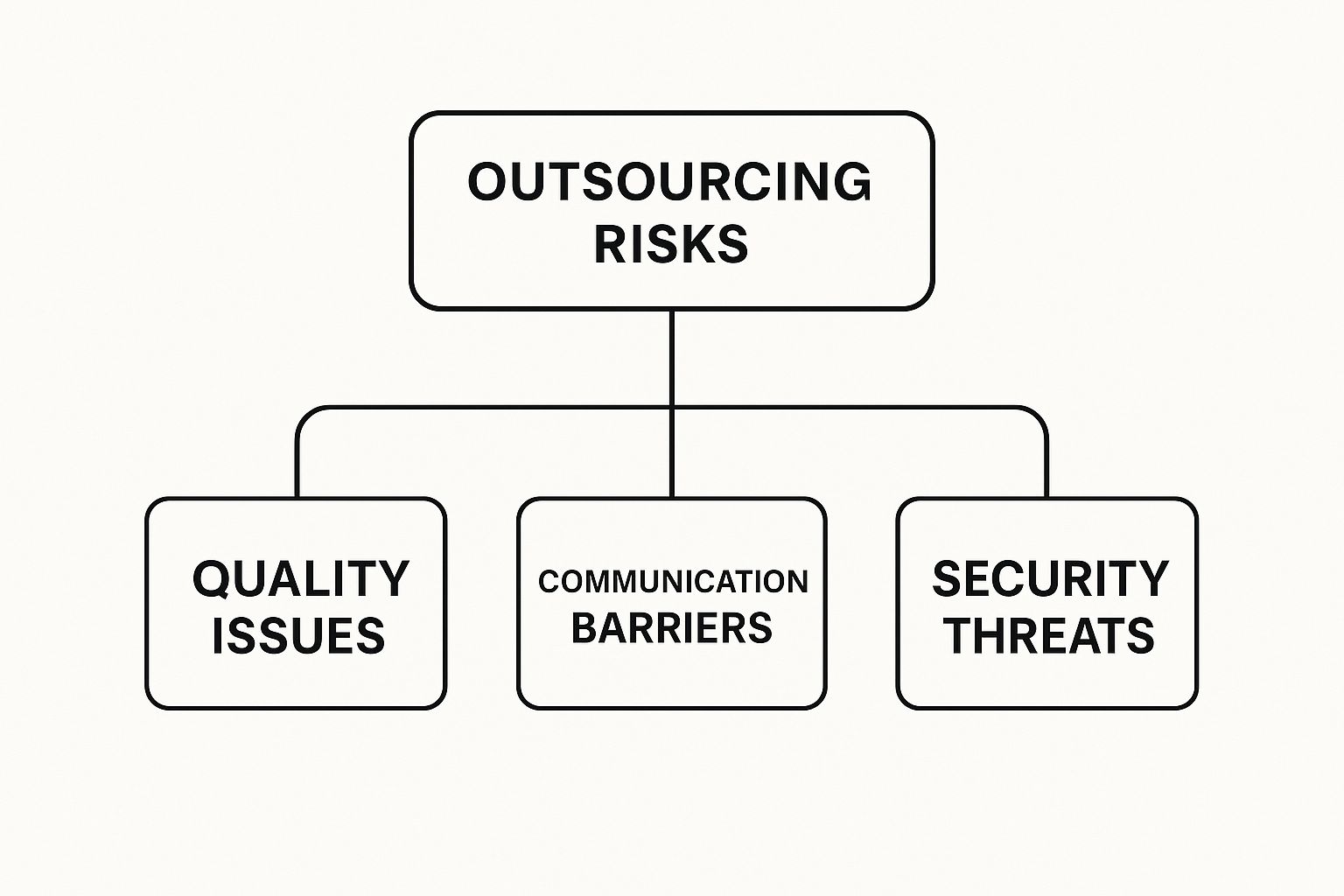
As you can see, every major risk—from tiny bugs to catastrophic data breaches—stems from a failure in one of these three domains: quality, communication, or security.
To help you get a quick handle on this, here's a simple breakdown of what to watch for.
Top 3 Outsourcing Risks at a Glance
Risk Category | Common Cause | Initial Mitigation Strategy |
|---|---|---|
Quality Control Failures | Misaligned expectations, lack of direct oversight, or poorly defined requirements. | Implement rigorous code reviews, automated testing, and crystal-clear project specs from day one. |
Communication Breakdowns | Time zone gaps, cultural differences, and using indirect channels (like a project manager who isn't technical). | Establish daily stand-ups, use shared communication platforms, and ensure direct access to developers. |
Security Vulnerabilities | Inadequate data protection protocols, weak access controls, or lack of compliance with your internal standards. | Extend your internal security policies to the outsourced team and conduct regular security audits. |
Mastering these three areas is your first and best line of defense against the most common pitfalls of outsourcing.
The old way of outsourcing—hiring a siloed, third-party team that you barely interact with—is exactly what makes these risks so dangerous. A new kind of staff augmentation is what we offer for global talent at the most affordable cost, a model focused on deeply integrating pre-vetted global talent right into your existing team.
This isn't just a small tweak; it's a fundamental shift designed to tackle classic outsourcing risks head-on. When you embed talent directly, communication flows naturally, you have direct eyes on quality, and your internal security protocols cover everyone. You get a single, cohesive team, not a disconnected "us vs. them" environment.
A New Approach to Global Talent
This evolution in workforce management is being supercharged by technology—especially AI—which is making it easier than ever to find, onboard, and manage top-tier contingent labor across different cultures and time zones. For any business serious about building a high-performance team, figuring out how to tap into these new models is non-negotiable.
Ready to learn how to structure your next project for success? Check out our complete guide to software development outsourcing. It will give you the tools you need to not just spot the risks, but turn them into a powerful competitive advantage.
Bridging the Gaps in Communication and Culture

Let's be blunt: when an outsourced project blows up, it’s almost never a technical problem. The real culprit is almost always bad communication.
Think of it like building a house with a team that can't agree on what a "foot" or a "meter" is. The blueprints might be perfect, but if everyone interprets them differently, you end up with a disaster. This is one of the most dangerous outsourcing software development risks because it silently poisons everything. You can hire the best coders on the planet, but if they’re building the wrong thing, their talent is worthless.
The problem gets worse when you factor in time zones, siloed teams in different countries, and wildly different ideas about what "done" means.
The old way of doing things—funneling all communication through a single project manager who probably doesn't even code—is a complete trainwreck. It's a game of telephone where every message gets distorted and critical feedback arrives too late. To avoid this, you have to engineer your communication just as carefully as you engineer your software.
Creating a Unified Communication Strategy
You can't just hope good communication happens. You have to design it. The goal is to create a single, shared brain for the project, where information flows without friction and context is never lost.
This starts with a clear protocol. Decide what tools are for what conversations. For example, Slack is for quick questions, Jira is for tracking work, and scheduled video calls are for hashing out the tough problems. Without this structure, important decisions get buried in random email threads and DMs.
Even more critical is establishing a ‘single source of truth’ for all documentation. This isn't just a folder on a server; it's a living repository—like a Confluence space or a meticulously organized GitHub wiki. When anyone, anywhere, needs the final word on a feature or design, they know exactly where to look. It kills the "but I thought..." excuse.
Standardizing how you talk and document isn't just about being efficient. It's about building a shared identity. You're creating a common language that cuts through cultural and geographical noise, which is the foundation for tackling nearly all other outsourcing software development risks.
Mastering Asynchronous and Cross-Cultural Collaboration
Working across time zones isn't a bug; it's a feature—if you know how to use it. The trick is to master asynchronous communication so that your live, synchronous meetings are laser-focused and high-impact.
Forget forcing one team to pull all-nighters for daily stand-ups. That just breeds resentment. A better model is a hybrid approach. Have teams post detailed daily updates in a dedicated channel. Then, a few times a week, get everyone on a video call to tackle blockers and talk strategy. This respects everyone's time while keeping the project aligned.
Cultural intelligence is just as vital. The way someone from Berlin gives feedback is very different from someone in Bangkok. A direct critique might be helpful in one culture and deeply offensive in another. To sidestep this landmine, you have to:
Set the Rules of Engagement: Be explicit. Write down how your team gives feedback, disagrees, and flags problems. Don't leave it to interpretation.
Make Questions Safe: Foster an environment where asking "dumb" questions is encouraged. Confusion is the enemy, and team members should never feel afraid to ask for clarity.
Build Real Connections: Get on video. Do virtual team lunches. When people know each other as humans, they build the trust needed to navigate the tricky stuff.
At the end of the day, this is about managing people, not just tasks. By embracing modern collaboration tools and building a culture of radical transparency, you stop managing a "vendor" and start leading an integrated global team. This approach, which is the core of a new kind of staff augmentation, doesn't just lower your risk—it turns your global talent pool into a weapon.
Protecting Your Data and Intellectual Property
Handing over your codebase, user data, and trade secrets is probably the most gut-wrenching part of outsourcing. It’s like giving the keys to your entire business to a contractor you just met online.
The threat of IP theft, a catastrophic data breach, or a GDPR fine isn't some abstract risk you can ignore. These are real-world threats with the power to crater your company's finances and reputation overnight.
Thinking a legal document alone will protect you is a rookie mistake. Real security is a combination of airtight legal agreements, relentless vetting, and disciplined operational habits. You need to scrutinize your partner’s security posture with the same intensity you apply to your own team.
This is more critical than ever as workforce management evolves. The workforce is shifting to flexible, global talent models like contingent labor. While that unlocks incredible cost savings and skills, it also dramatically expands your attack surface. You need a partner who gets this—not one stuck in a security mindset from five years ago.
Vetting Your Partner's Security Posture
Before you even think about signing a contract, you have to do your homework. A slick sales deck is worthless if their security practices are a house of cards. Your job is to cut through the promises and demand hard evidence of how they protect your assets.
Start by asking for their internal security policy documents. Do they actually run background checks on their developers? What are their data access protocols? A mature, trustworthy partner will have this information ready to go and won't flinch when you ask for it.
Here’s a practical checklist to guide you:
Data Encryption Standards: Don't just ask if they encrypt. Ask how. What specific protocols do they use for data in transit (APIs, file transfers) and data at rest (on their servers)?
Access Control Policies: Who gets to see your code? Is access tied to specific roles and logged religiously? They should be able to prove they operate on a "least privilege" basis.
Employee Screening and Training: Do they perform background checks? How often are their people trained on spotting phishing attacks and other common security threats?
Compliance and Certifications: Have they been audited for standards like SOC 2 or ISO 27001? This is one of the strongest signals of a serious, mature security program.
Disaster Recovery Plan: What happens when—not if—things go wrong? A concrete business continuity and disaster recovery plan isn't a "nice-to-have"; it's a deal-breaker.
Crafting Ironclad Legal Agreements
Your legal agreements are your last line of defense. Trust is important, but a well-drafted contract is what saves you when that trust is broken. Two documents are absolutely non-negotiable: the Non-Disclosure Agreement (NDA) and the Master Services Agreement (MSA).
The NDA needs to be signed before you share anything sensitive. It legally binds the partner to shut up. The MSA, however, is where the real teeth are. It must state, in no uncertain terms, that you retain 100% ownership of all intellectual property. That includes every line of code, every design file, and every document they create for you.
Your MSA is the ultimate rulebook. It must clearly define security responsibilities, breach notification procedures, and penalties for non-compliance. This isn't just a formality; it's a critical tool for risk mitigation.
To really lock down sensitive information, you need a system. For a deep dive into how to safeguard your files and data, this comprehensive document security playbook offers some powerful strategies.
The financial stakes here are astronomical. As of 2025, a shocking 58% of mid-sized firms have no dedicated in-house security staff, forcing them to outsource this critical function. The irony? The solution can become the problem. A 2024 study showed that nearly 30% of all data breaches involved a third party, with the average cost of an incident now soaring above $4 million. You can read more about these software development outsourcing statistics to understand the full financial fallout.
2. Ensuring Technical Quality and Project Alignment

There are few things more gut-wrenching than getting to the end of an outsourced project, only to find the final product is a buggy mess that completely misses the point of what you were trying to build. This isn't just a simple quality problem—it's a sign of a deep, fundamental misalignment that torches your investment and leaves you with a mountain of technical debt.
This particular outsourcing software development risk almost always starts small, with fuzzy requirements and a quiet mismatch in skill sets. It grows in the dark, fed by a lack of proactive quality control until your project becomes a frantic, reactive cycle of bug-fixing instead of a focused push toward delivering real value.
To sidestep this disaster, you have to ditch the old "test at the end" mentality. Quality isn’t a final step; it’s something you weave into the fabric of the development process from day one. It's about building a system of checks and balances that guarantees the project stays true to your vision, both technically and strategically.
From Vague Specs to Crystal-Clear Criteria
Let's be blunt: most quality failures aren't born from bad code but from bad instructions. When your acceptance criteria are vague, you're forcing developers to guess. Every single guess is a potential fork in the road, a point where the final product can drift miles away from what you actually needed.
It’s like hiring an artist to paint a portrait. If you just say, "paint my grandfather," you have no right to be upset when he comes back with a mustache and glasses. You needed to provide the reference photo.
In software, this means you must go deeper than high-level feature descriptions. Your team needs detailed user stories and crystal-clear acceptance criteria that leave zero room for interpretation. "Done" has to mean the exact same thing to everyone involved.
This isn't just about managing the team; it's about forcing yourself to clarify your own thinking. When you do this, you hand the developers an unambiguous map to success. For a deeper dive, this agency-specific guide to software development project management is a fantastic resource for steering complex projects.
Embedding Quality Into the Workflow
Waiting until the end of a two-week sprint to check for quality is a guaranteed recipe for failure. By that point, a flaw that was once a tiny crack has become a foundational problem, and fixing it will cost you dearly in both time and money. The only way to win is to make quality assurance a continuous, automated part of the daily workflow.
This is where a modern CI/CD (Continuous Integration/Continuous Deployment) pipeline becomes your best friend. Think of it as a tireless, vigilant gatekeeper that automatically runs a battery of tests every single time a developer tries to add new code. It catches errors the moment they happen, stopping them long before they contaminate the main project.
Here’s how you build a real culture of proactive quality:
Mandatory Code Reviews: This is non-negotiable. No code gets merged until at least one other developer has reviewed it. It’s a simple habit that crushes bugs, enforces standards, and makes the whole team smarter.
Automated Testing: Build a comprehensive suite of tests—unit, integration, and end-to-end—that runs on its own. This is your first line of defense against dumb mistakes and unexpected regressions.
Regular Demos: Get your outsourced team to show you their work in frequent, consistent demo sessions. This is your chance to give real-time feedback and steer the ship, correcting tiny course deviations before they turn into major navigational errors. You can find more practical advice in these IT project management best practices for success.
This kind of hands-on, proactive approach is what separates a true integrated global team from a hands-off vendor. Your partner should adopt your quality standards as their own, effectively becoming an extension of your engineering culture. This ensures the product you get at the end isn't just "done," but that it delivers tangible, measurable business value.
Avoiding Hidden Costs and Vendor Lock-In

The proposal lands on your desk and the numbers look fantastic. The hourly rate is a fraction of what you’d pay locally. On paper, it’s a clear win. But this is the oldest, most deceptive trap in software outsourcing. The real cost isn't the number on that initial quote.
The sticker price is just the beginning. The actual cost is a messy, complicated beast. You have management overhead trying to herd a team across the world. You have currency swings eating into your budget. You have developers burning hours just trying to sync up across a 12-hour time difference.
Worst of all? You have the soul-crushing expense of rewriting shoddy code. That’s a debt that never gets paid off; it just keeps compounding.
This financial nightmare is tied directly to a strategic poison pill called vendor lock-in. It’s what happens when your partner builds your software in a way that makes it practically impossible to leave them. You're no longer a client; you're a hostage, chained to their proprietary tools, their specific processes, and the knowledge locked inside their team's heads.
Escaping the Vendor Lock-In Trap
Let's be clear: vendor lock-in isn't an accident. It's the natural result of a broken, old-school outsourcing model. If you want to keep your freedom and control your own destiny, you have to be aggressive about it from day one. You need to demand things that guarantee your independence.
The entire game is about making sure your codebase is clean, portable, and understandable to any good developer on the planet—not just the ones who wrote it. You’re paying to build an asset for your company, not a black box that only your vendor can open.
These aren't suggestions; they are non-negotiable demands to stay out of the trap:
Demand Standards-Based Code: Your contract must insist on development that follows mainstream, widely accepted industry standards. No proprietary frameworks. No weird, custom tools that only they know how to use.
Enforce Rigorous Documentation: Don't treat documentation as an afterthought. It's a critical deliverable. This means everything from inline code comments to high-level architecture diagrams, ensuring a new team can hit the ground running.
Secure Full IP Ownership: This is non-negotiable. The contract must state, in no uncertain terms, that you own 100% of the intellectual property. Every single line of code, every design file, all of it. No exceptions, no fine print.
This isn't just about avoiding risk; it’s a modern approach to building a global team. The goal isn't to rent developers. It's to integrate world-class talent to build your company's assets and institutional knowledge, not your vendor's.
Building a Continuous Knowledge Transfer Process
The only real way to kill vendor lock-in for good is to make knowledge transfer a daily habit, not a desperate, last-minute scramble when you’re trying to fire them. This is the fundamental difference between old-school outsourcing and a modern staff augmentation model.
Forget about siloed teams. This emerging trend in workforce management is about integration. You embed the external developers directly with your in-house people, creating one blended, cohesive unit. Knowledge flows naturally because they're working side-by-side on the same problems. Your internal team learns the codebase as it’s born.
This model, often supercharged by platforms that handle the complexity of global talent management and contingent labor, gives you the cost benefits of a global workforce with the control and integration of an in-house team. It's your single best defense against the hidden costs and strategic traps of traditional outsourcing.
Flipping the Script on Risk with Modern Teams and AI
Let's be blunt: the old way of outsourcing is a magnet for risk. The whole model of shipping a project spec to a siloed team on the other side of the world is precisely why things go wrong. That approach is a relic. Building global teams today isn't about a race to the bottom on price; it's about building smarter, deeply integrated teams that deliver real value and sidestep those classic, painful pitfalls.
The game has changed. We're moving away from the fire-and-forget project model and into a much more sophisticated way of thinking about workforce management. The new approach, a new kind of staff augmentation, is about embedding elite, pre-vetted global talent directly into your crew. They aren't just "external contingent labor"—they become your people, breathing your culture and chasing your goals.
A New Breed of Global Talent Integration
This shift completely rewrites the risk equation. When you truly integrate talent, you instantly dissolve the communication walls that plague traditional outsourcing. Your local engineers have a direct, real-time line to their augmented colleagues. The dangerous game of "telephone" through a non-technical project manager? Gone.
This single change directly attacks some of the most stubborn outsourcing software development risks:
No More Guesswork: You get direct oversight. Quality control isn't a surprise at the end of a sprint; you see the work as it happens and can give feedback on the spot.
Real Cultural Fit: Integrated members don't just get a project brief; they absorb your company's work ethic, your communication quirks, and your standards. Friction drops dramatically.
Knowledge Stays Home: Because augmented pros work shoulder-to-shoulder with your team, knowledge transfer is constant and organic. The risk of a vendor holding your code or institutional knowledge hostage evaporates.
This isn't just a different way to hire. It's a strategic play to get the cost benefits of a global talent pool without giving up an ounce of control, quality, or security. It’s simply a more mature, effective way to build your team.
How AI De-Risks the Entire Process
This evolution is getting a massive boost from advancements in technology—specifically, from AI. Specialized platforms are now using AI to surgically remove risk from the process of finding, vetting, and managing global talent. This is a key emerging trend in workforce management.
Forget sifting through resumes and hoping for the best. AI-powered systems can analyze a developer’s actual code, their performance metrics, and even communication patterns to find a genuine match for your project and your team's culture. For tech leaders, this data-first approach is a massive leap forward. You can dig deeper into the key staff augmentation benefits for tech leaders in 2025 to see just how big of an impact this makes.
On top of that, these platforms automate the soul-crushing admin work—onboarding, global payroll, compliance—while feeding you real-time analytics on how your team is performing. The right AI can even analyze communications to flag potential misunderstandings before they become full-blown problems.
It's this one-two punch of superior talent integration and AI-driven management that creates a transparent, low-risk, and brutally efficient environment for building a world-class team.
Frequently Asked Questions
Outsourcing can feel like a minefield. You've got questions, and frankly, you should. Here are some straight answers to the most common concerns I hear from leaders trying to build software with global teams.
What Is the Single Biggest Risk in Outsourcing Software Development?
Forget the technical stuff for a second. While security and quality get all the attention, the real project-killer is almost always communication breakdowns.
It’s the silent killer. Misaligned expectations, cultural gaps that go unspoken, and vague requirements are what turn a promising project into a money pit. The result? You blow your budget and end up with a product that’s basically useless.
This is exactly why investing in a solid communication framework is non-negotiable. It’s also the key reason why modern staff augmentation—where you embed global talent directly into your team—is so much safer than the old-school, siloed outsourcing model.
How Can I Protect My Intellectual Property When Outsourcing?
You can't just cross your fingers and hope for the best. Protecting your IP demands a few critical layers of defense.
First, the legal basics: get a rock-solid Non-Disclosure Agreement (NDA) and a Master Services Agreement (MSA) in place. Make it crystal clear that you own 100% of the code and all work products. No ambiguity.
Next, do your homework on the partner. Scrutinize their security practices, lock down access to sensitive data, and make sure they have a clean legal track record. Most importantly, run from any partner who wants to use proprietary code that you can't fully own or take with you. That's a trap.
The safest bet? Work with partners who operate as a true extension of your team. They should follow your internal security rules and give you total transparency. This deep integration is what sets modern workforce platforms apart.
Is a Fixed-Price or Time-and-Materials Contract Better for Reducing Risk?
There's no magic bullet here. Each model just moves the risk around. A fixed-price contract seems safe because it protects your budget, but it can backfire. If the vendor starts losing money, they'll be tempted to cut corners, and quality is the first thing to go.
A time-and-materials (T&M) contract gives you flexibility, but you carry the risk of the budget spiraling out of control.
For most real-world projects, the sweet spot is either a hybrid model or a T&M contract with guardrails. This means setting clear budget caps, holding regular progress reviews, and demanding transparent reporting. It gives you the best of both worlds: the flexibility to adapt and the control to protect your finances.
Managing outsourcing software development risks is a lot less daunting when your partner is built for how teams work today. Shorepod offers a new take on staff augmentation, connecting you with elite, pre-vetted global talent at an unbeatable cost. Our platform embeds engineers right into your existing team, wiping out the communication and quality risks that plague traditional outsourcing.