Mastering Time to Hire Metrics for Faster Hiring
- Ron Smith

- Oct 10
- 15 min read
Time to hire isn't just another number for your HR dashboard. It’s the total number of days from when a candidate first enters your orbit—say, by hitting 'apply'—to the moment they accept your job offer.
Think of it less as a stopwatch and more as a stethoscope for your company's operational health. A low number is a great sign; it points to a smooth, well-oiled hiring machine. A high number? That’s your check engine light. It’s a clear signal of friction, bottlenecks, and missed opportunities.
What Time to Hire Actually Tells You

This metric is a powerful diagnostic tool for your entire talent acquisition process. It’s not just about speed. It reveals the true health of your hiring engine, because every single day that ticks by is another piece of data telling a story about your efficiency, your candidate experience, and where you stand against the competition.
When that number starts climbing, it's a massive red flag. It’s often the symptom of deeper problems: sluggish approval processes, chaotic interview scheduling, or a total communication breakdown between recruiters and hiring managers. Worse yet, a drawn-out process creates a terrible experience for candidates. Top talent won't wait around—they often have competing offers within days.
On the flip side, a low time to hire is proof that you've got your act together. It shows your teams are in sync, your workflows are dialed in, and you can act decisively to lock down the best people before anyone else gets a chance. That kind of agility is a non-negotiable in today's cutthroat job market.
Why This Metric Is a Competitive Advantage
In the talent game, speed and efficiency are everything. Sure, a faster hiring process cuts down the costs that come with having an empty seat. But the real value goes so much deeper than that.
A fast, professional, and respectful hiring process sends a powerful message about your company culture. It tells candidates you value their time and that you’re organized and decisive—exactly the kind of signals that attract high-performers.
Getting a handle on your time to hire is a crucial first step, but it’s just one piece of the puzzle. To really build a strong and resilient team, you have to be tracking other essential talent acquisition metrics for 2025 to get the full picture of your recruiting health.
The Evolution of Workforce Management
Let's be honest, the old-school way of filling roles is getting turned on its head. Smart companies are looking past traditional hiring and embracing more flexible, on-demand solutions. The boom in contingent labor, powered by advancements in AI, is letting businesses find and bring on talent faster than ever.
This shift has opened the door for new models, like a smarter form of staff augmentation. Instead of getting stuck in long, drawn-out recruitment cycles, you can now tap into a global pool of pre-vetted experts at an affordable cost. This approach gives you an immediate way to access world-class engineers, completely sidestepping the usual delays that blow up your time to hire metrics. It’s about building agile, global teams, instantly.
How to Calculate Your Time to Hire Correctly
Alright, let's get down to brass tacks. Moving from theory to practice doesn't require a data science degree or some overly complicated algorithm. Calculating your time to hire is really about setting clear, consistent goalposts for your entire recruiting process.
At its core, the formula is refreshingly simple and focuses entirely on the candidate’s journey.
The calculation is just this: Day a Candidate Accepts an Offer - Day they Entered Your Pipeline.
This candidate-centric view is what makes time to hire so powerful. It’s not the same as time to fill, which just measures how long a role sits open. Time to hire zooms in on the active part of the process—how efficient are you after a candidate is actually in your system?
Nailing Down Your Start and End Points
Here’s where most companies get it wrong: inconsistency. If your sales team starts the clock when a candidate applies, but engineering starts it when a recruiter first makes contact, your data is garbage. You can't compare apples to oranges and expect to find any real insights into your time to hire metrics.
To get this right, you need to define two non-negotiable points for everyone.
The Official Start Date: This is almost always the day a candidate hits "submit" on their application, whether through your careers page, a job board, or when a recruiter manually enters them into your Applicant Tracking System (ATS). It creates a clean, undeniable timestamped entry point.
The Official End Date: This is the date the candidate formally accepts your written job offer. A verbal "yes" is a great sign, but the signed offer letter is the concrete, documented finish line.
When you standardize these two events for every single hire across the organization, you’re finally building a foundation of clean, reliable data you can actually use.
The accuracy of your time to hire metric is only as good as the consistency of your measurement. Without universal start and end points, you're just tracking noise, not actionable intelligence about your hiring speed.
A Practical Calculation Example
Let's walk through a real-world scenario. Imagine you're trying to hire a Senior Software Engineer.
A promising candidate, Alex, applies for the job on July 5th. That's your Start Date.
Alex goes through the gauntlet—the phone screen, a couple of technical interviews, and the final culture-fit chat over the next few weeks.
You send out the formal offer, and Alex signs the contract on July 29th. This is your End Date.
The math is simple: July 29th (End Date) - July 5th (Start Date) = 24 days.
Your time to hire for this specific role was 24 days. Now, imagine doing this for every single hire. You can start to see averages for different departments, roles, and seniority levels. This is how you pinpoint exactly where your hiring process is getting bogged down, turning a simple number into a powerful tool for fixing your entire talent strategy.
Uncovering the Bottlenecks That Inflate Hiring Time
A painfully long time to hire is almost never the result of one big, obvious problem. It's more like death by a thousand paper cuts—dozens of small frictions that add up to grind your entire hiring process to a halt.
These seemingly minor delays compound over weeks, frustrating candidates, burning out your team, and ultimately costing you the best people.
The first place to look is usually the administrative quicksand your team is stuck in. Think of the endless email chains just to schedule one interview. The manual data entry into three different systems. The messy, disorganized candidate feedback. Each one feels small, but together, they create a massive drag on the entire system.
This breakdown shows the common stages where bottlenecks hide, slowing down your entire recruitment pipeline.
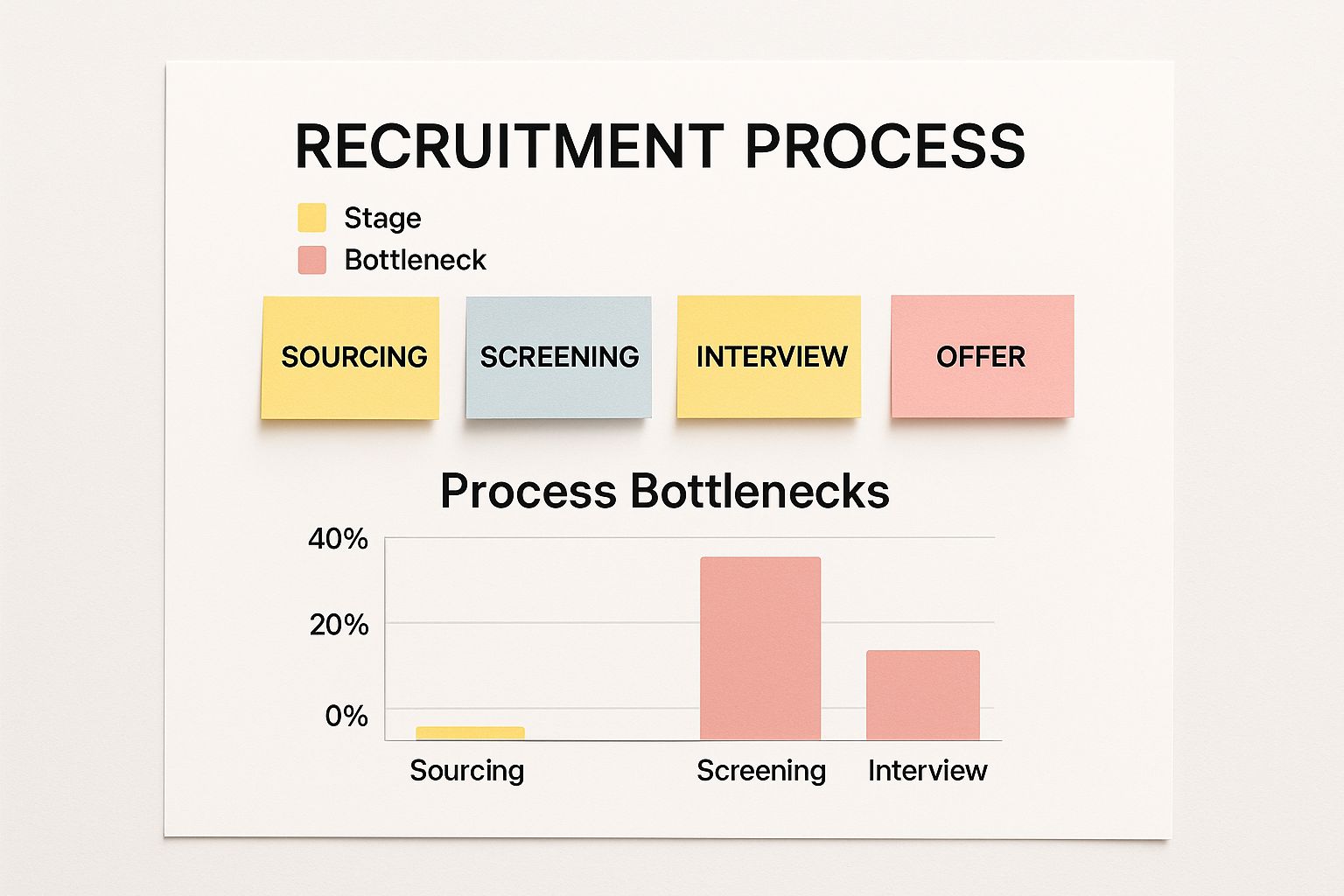
When you map out each step, you can finally see exactly where the delays are happening. It turns abstract frustration into a clear roadmap for improvement.
The Weight of Administrative Overload
In today’s talent market, recruiters are stretched thinner than ever. The complexity of hiring keeps growing, with 45% of TA leaders reporting that far more candidate touchpoints are now required just to get the job done. This administrative burden is a huge driver of high time to hire metrics.
A staggering 35% of a recruiter's time is eaten up by interview scheduling alone—a task practically begging for automation, yet still stubbornly manual in most companies. This is made worse by the fact that 27% of talent acquisition leaders admit their teams are drowning in unmanageable workloads.
When your talent team spends more time coordinating calendars than they do talking to high-potential candidates, your hiring process is fundamentally broken. It’s a terrible use of skilled people that directly leads to longer hiring cycles and lost opportunities.
Communication Gaps and Misaligned Expectations
Another major bottleneck? The communication breakdown between recruiters and hiring managers. When these two key players aren't on the same page, the process simply stops.
This misalignment usually shows up in a few classic ways:
Vague Job Descriptions: A poorly defined role brings in a flood of unqualified applicants, forcing everyone to waste time screening people who were never a fit.
Delayed Feedback: Hiring managers who take days (or weeks) to give feedback on candidates leave recruiters in limbo and top applicants feeling ignored.
Shifting Requirements: Nothing kills momentum like the "ideal candidate" profile changing mid-search. It forces the recruiting team to hit reset, adding weeks to the timeline.
This lack of alignment creates a frustrating cycle of rework that needlessly drags out the hiring process. For a deeper look at fixing these kinds of systemic issues, check out this comprehensive guide to recruiting process improvement.
The Peril of Excessive Interview Rounds
Finally, an overly complicated interview process is a guaranteed way to kill your hiring speed. Thoroughness is one thing, but adding too many stages often gives you nothing in return while massively increasing the risk of candidates just giving up and walking away.
A six-round interview process for a mid-level role isn't impressive; it's a red flag for candidates that signals indecisiveness or a bureaucratic nightmare.
This is especially true for technical roles. A convoluted process will scare off top engineers who are almost always juggling multiple offers. To better understand how to structure these critical conversations, check out our guide on navigating the software engineer interview process.
The good news is that smart companies are rethinking these outdated practices. AI-powered screening tools can consolidate the early stages, while new staff augmentation models offer a way to bypass these bottlenecks entirely. By providing access to pre-vetted global talent, you can get the skills you need on demand, sidestepping the long, friction-filled traditional hiring cycle and dramatically improving your ability to scale teams quickly and affordably.
Proven Strategies to Reduce Your Time to Hire

So, you’ve pinpointed the bottlenecks bloating your time to hire metrics. What now? The next step is to dismantle them, piece by piece.
Let’s be clear: shrinking your hiring timeline isn't about rushing decisions or cutting corners. It's about surgically removing friction from the process—creating a system that respects everyone's time. Yours, your team's, and most importantly, your best candidates'.
The real goal is to shift from a reactive, sluggish process to one that’s proactive and decisive. This takes more than just a few tweaks; it requires a mix of smarter processes, the right tech, and a fundamental change in how you approach talent acquisition.
Embrace Technology and Automation
One of the biggest drags on any hiring process is the sheer weight of manual, administrative tasks. This is where advancements in technology become a total game-changer, especially when it comes to the black hole of scheduling.
It's a huge problem. A shocking 35% of a recruiter’s time is eaten up just by scheduling interviews. That’s a massive resource drain and a direct cause of the delays that kill your momentum. Think about it—endless email chains, last-minute cancellations, and rescheduling nightmares.
AI-powered scheduling tools can eliminate this gridlock completely. By plugging into everyone’s calendars, these platforms let candidates book their own interview slots, instantly finding a time that works for the whole hiring panel. This one change can literally shave days off your timeline.
Build a Proactive Talent Pipeline
Why are you starting from scratch every single time a role opens up? Stop it.
Proactive talent pipelining means building relationships with great potential candidates before you even have an open position. It’s the difference between having a fully stocked pantry and having to run to the grocery store every time you want to make dinner.
This isn't complicated. It just involves a change in mindset:
Engage passive candidates: Start conversations with interesting professionals on platforms like LinkedIn, even if they aren't actively job hunting.
Create a talent community: Use a simple newsletter or a private group to share company news and industry insights. It keeps potential hires warm and engaged.
Revisit your "silver medalists": That awesome candidate who was the runner-up for a previous role? Stay in touch. They could be the perfect fit for the next opening.
When a new role gets approved, a healthy pipeline means your recruiting team already has a shortlist of qualified, interested people to call. Game on.
Optimize and Structure the Interview Process
A long, meandering, and unstructured interview process is the fastest way to lose top talent. Every extra round you add is another opportunity for your dream candidate to accept an offer somewhere else.
The goal of an interview process is to gather the data needed to make a confident hiring decision as efficiently as possible. Anything beyond that is just corporate theater, and it’s slowing you down.
To fix this, focus on two things: consolidating rounds and structuring interviews. Ask the hard questions. Can those three separate one-hour interviews be combined into a single, focused two-hour block with everyone present?
Even more important is implementing structured interviews. This means every candidate for a given role gets asked the same set of predetermined, job-related questions. It not only reduces bias but also makes evaluating candidates faster and more consistent. Your team can make quicker, data-driven decisions instead of relying on "gut feelings."
Below is a quick comparison of different strategies you can implement, highlighting how they stack up in terms of impact and effort.
Comparing Strategies to Improve Hiring Speed
Strategy | Potential Impact | Implementation Effort | Example Action |
|---|---|---|---|
Tech & Automation | High | Low to Medium | Implement an AI-powered interview scheduling tool to eliminate back-and-forth emails. |
Talent Pipelining | High | Medium | Create a company newsletter to share updates with a curated list of "silver medalist" candidates. |
Structured Interviews | Medium | Low | Develop a standard question bank for a high-volume role and train hiring managers on its use. |
Interview Consolidation | Medium | Low | Combine first and second-round interviews into a single, multi-interviewer "panel" session. |
Rethinking Models | Very High | High | Partner with a firm that provides pre-vetted, on-demand global talent to bypass traditional hiring. |
Each approach offers a different lever to pull, but the most successful recruiting functions combine several of these to create a truly efficient machine.
Rethink Traditional Workforce Models
Sometimes, the best way to speed things up is to change the game entirely. Emerging workforce management trends, like the rise of contingent labor, offer a direct route around the usual hiring delays.
A new breed of staff augmentation is flipping the script. Instead of the linear, step-by-step slog of traditional recruitment, this model gives you on-demand access to a pre-vetted, global pool of engineers and tech experts at the most affordable cost. It effectively bypasses the sourcing, screening, and scheduling bottlenecks that plague most companies. You can build a world-class team, affordably, almost overnight.
It also helps to look at the process from the other side of the table. Understanding the strategies for candidates to get hired faster can reveal their biggest frustrations and expectations. This insight is gold, helping you design a hiring process that meets them where they are and wins them over.
How Market Trends Screw Up Your Hiring Speed
Your company's time to hire isn't just about how efficient your team is. It's a direct reflection of the absolute chaos happening in the wider labor market.
Think of it like this: you can be the best rower in the world, but if the tide is ripping out to sea, you’re not getting to shore anytime soon. That’s what’s happening right now. Intense skills shortages, brutal competition for the same people, and sky-high candidate expectations are dragging out hiring cycles for everyone.
Even a perfectly tuned recruiting engine will sputter when facing these kinds of headwinds. You have to get real about this context if you want to set goals that aren't pure fantasy.
Welcome to the New Talent Battleground
Let's be blunt: it's a candidate's market. Top-tier professionals, especially in fields like tech, are swimming in offers. This isn't just competition anymore; it's a street fight for talent where speed is your only real weapon.
This new reality blows up your hiring timeline in a few critical ways:
Bidding Wars are the Norm: Companies are getting dragged into salary bidding wars, which means more red tape, more approvals, and more time wasted at the offer stage.
Your Competitors are Poaching: While you’re deliberating, your rivals are actively sliding into your top candidate's DMs. Any delay on your part is an open invitation for them to steal your best prospect.
Candidates Expect the Red Carpet: Today’s talent demands a fast, transparent, and almost concierge-like experience. A slow, clunky process doesn’t just look bad—it screams "this company is a mess."
These forces create a perfect storm where a one-day delay can mean losing your top choice for good.
Dodging Ghosters and Bridging Skills Gaps
It’s not just the competition. The very way candidates behave has changed, adding a whole new layer of insanity to the process. The rise of "ghosting"—where applicants just vanish without a trace—has become a massive problem.
This isn't just bad manners; it's a clear signal that candidates hold all the power and feel zero obligation to play by the old rules. The steady climb in time-to-hire is directly tied to these trends. A huge chunk of companies have struggled to recruit, blaming a lack of applicants (60%), competition (55%), candidate ghosting (46%), and applicants who just don't have the right experience (40%). You can dig into more of this data with these recruitment and training statistics.
When a big piece of your pipeline can evaporate overnight, you realize two things: you need a much bigger talent pool, and you need a process that keeps people hooked at every single step.
This is where the old, linear hiring funnel completely falls apart. To survive, smart companies are looking for new solutions that give them an edge. AI is starting to help identify and engage passive candidates better, keeping the pipeline from running dry.
But there’s another, more powerful play: a new breed of staff augmentation. By giving you on-demand access to a pre-vetted, global talent pool, this model lets you sidestep the volatility of the local job market entirely. It's a faster, more affordable way to get the world-class skills you need, insulating your projects from the chaos and keeping your teams moving.
The Future of Building Global Teams Instantly
Let's be honest. The old way of hiring—that sluggish, linear process we've all been forced to accept—is officially obsolete. In today’s world, a long time to hire isn't just an unfortunate delay; it's a strategic failure.
The emerging trends we're seeing in workforce management aren't just about patching up a broken system. They're about tearing up the old rulebook entirely. The future of finding talent is all about speed, agility, and having a truly global reach.
At the heart of this shift is technology, specifically advancements in AI. But this isn't the AI that just automates scheduling. We're talking about AI as a powerful predictive engine, one that can analyze massive amounts of data to find the perfect global candidate before they even think about applying.
But smart tech is only half the story. The real game-changer is pairing it with new, incredibly flexible ways of building a workforce through contingent labor.
AI and Predictive Hiring
Today's AI tools are flipping the script on how we identify talent. Forget just scanning resumes for keywords. These systems can dive deep, analyzing a person's actual skills, their career path, and even their public contributions to predict how well they’d fit not just the role, but your company culture.
This means recruiting teams can finally stop being reactive—just sitting around waiting for applications to trickle in. Instead, they can get proactive. They can find and start conversations with amazing people who aren't even looking for a job but are a perfect match for what you'll need next.
This alone slashes the time spent on sourcing and screening, which are easily two of the biggest time sinks in any hiring cycle.
A New Model of Staff Augmentation
The biggest leap forward, though, is a totally new take on staff augmentation built for a world that needs talent now. This model directly attacks the root cause of painfully high time-to-hire metrics: the friction, the endless vetting, and the slow onboarding of one person at a time.
This approach completely sidesteps the traditional hiring funnel. How? By giving you direct access to a pre-vetted, global pool of talent.
This isn't just about filling an open req a little faster. It's about having world-class talent on tap, ready to go the moment you need them. It turns hiring from a months-long marathon into an on-demand service.
This model is a strategic advantage for any company that wants to build an agile, elite team without the insane costs and delays. If you're looking to tap into this global talent pool, getting the logistics right is everything. A great starting point is this practical guide on [how to hire international employees](https://www.shorepod.com/post/how-to-hire-international-employees-a-practical-guide), which breaks down how to make it happen.
By connecting businesses with top-tier global talent at the most affordable cost, this new kind of staff augmentation makes building elite engineering teams almost instant. It's a fundamental shift from slow, one-by-one hiring to a dynamic, continuous stream of talent that actually keeps up with the speed of business.
Your Time to Hire Questions, Answered
Let's cut through the noise. Here are the straight answers to the questions I hear most often about time to hire. No jargon, just practical advice to help you get this right.
What’s a “Good” Time to Hire, Really?
Everyone wants a magic number, but there isn't one. You'll see 30-40 days thrown around as a healthy average, but that's a dangerous benchmark to chase blindly. A software engineer role in San Francisco won't have the same timeline as a customer service rep in Omaha. It just doesn't work that way.
The only benchmark that truly matters is your own. A "good" time to hire is simply one that's consistently improving month over month without you having to sacrifice the quality of the people you bring on board. Focus on beating your own record, not some generic industry stat.
Time to Fill vs. Time to Hire: What’s the Difference?
Getting this wrong is a common mistake, but the distinction is critical.
Time to fill is the big picture. It’s the entire calendar timeline from the moment a job req gets approved to the second your new hire signs the offer letter. This number tells you a story about your internal machinery—how fast approvals move, how aligned your hiring managers are, and the overall health of your operations.
Time to hire zooms in on the candidate's experience. It measures the time from when a specific person applies (or is sourced) to when they accept the offer. This is a pure measure of your recruiting team's speed and effectiveness. It shows you exactly how long it takes to move a great candidate through your process.
Won't a Faster Process Mean Lower-Quality Hires?
It can, but only if you're hacking away at the wrong things. The goal isn't to rush interviews or skip reference checks—that's a recipe for disaster. It's about eliminating the dead time, the administrative black holes where great candidates get lost.
Think about the scheduling back-and-forth, the delayed feedback, the internal misalignment. That’s the friction you need to remove.
A sharp, efficient hiring process doesn't compromise quality; it protects it. Top talent won't wait around for a slow, clunky experience. By trimming the fat from your process, you keep your best candidates engaged and get them to sign before your competitors even get a chance.
This is where the entire model is shifting. Instead of just tweaking the old, slow hiring cycle, the smartest companies are bypassing it. New approaches to staff augmentation are emerging that give you instant access to a global pool of pre-vetted, high-quality talent. You're not just reducing your time to hire metrics—you're eliminating them entirely for key roles, letting you build elite teams on demand.
At Shorepod, we offer a new kind of staff augmentation that provides vetted, global engineering talent on demand. Skip the long hiring cycles and build your dream team affordably and instantly. Learn more at https://www.shorepod.com.
Comments