How to Recruit Software Developers The Modern Way
- Ron Smith

- Oct 7
- 14 min read
The old hiring playbook? It’s broken. If you want to recruit software developers who can actually move the needle, you have to stop posting jobs and waiting for the magic to happen. It won't.
The modern game is all about proactive sourcing, tapping into global talent pools, and using smarter workforce models like staff augmentation to build elite engineering teams without breaking the bank.
Navigating the New Era of Tech Recruitment

Let's be honest—the market for software developers is a battlefield. It’s fiercely competitive and shifts on a dime. The old-school methods of relying on local talent and only hiring when you’re desperate just don’t cut it anymore. Why? Because the demand for specialized skills is through the roof, and the best candidates aren't even looking. They're passive, happy in their current roles, and you have to go find them.
This guide is your new roadmap. We’re going to walk through the fundamental shifts in how smart companies are building their tech teams today. These aren’t just passing trends; they represent a total rethink of what it takes to build and keep a high-performing engineering workforce, educating on emerging trends in workforce management and technology.
The Shift to a Global and Flexible Workforce
The smartest companies have realized their next great hire probably doesn't live within a 20-mile radius. They're looking globally to find the right skills at a cost that makes sense. This has opened the door to more agile and efficient ways of building teams, reflecting major advancements in workforce management.
Here’s what’s working now:
Contingent Labor: Need to fill a skills gap fast? Businesses are increasingly using contingent labor, bringing on contract developers to get the job done without the long-term commitment and overhead of a full-time hire. It’s all about scaling up or down as your project demands.
AI in Sourcing: This is a game-changer. Advancements in technology like AI are now essential for finding and engaging those hard-to-reach passive candidates across the globe. These platforms sift through mountains of data to pinpoint developers with the exact skills you need, making your outreach hyper-targeted and way more effective.
A New Kind of Staff Augmentation: Forget traditional temp staffing. A new kind of staff augmentation gives you direct access to pre-vetted global talent at the most affordable cost. Platforms like Shorepod handle all the messy parts—like international payroll and compliance—so you can focus on building incredible products. Making this work requires a solid talent management strategy that pulls these modern approaches together.
The software developer job market is set to grow by a staggering 17% between 2023 and 2033, which means nearly 327,900 new jobs. After some recent turbulence, the market has found its footing. Now, the focus is squarely on efficiency and finding highly specialized skills, not just generalist credentials. You can get more details on the evolving software engineer job market on mev.com.
To really grasp the difference, let’s look at how the old way of hiring stacks up against the modern, TaaS-driven approach.
Traditional vs Modern Recruitment Approaches
Aspect | Traditional Approach | Modern Approach (TaaS) |
|---|---|---|
Talent Pool | Local, limited to a specific geographic area. | Global, accessing the best talent from anywhere in the world. |
Hiring Speed | Slow and reactive, often taking months to fill a single role. | Fast and proactive, with pre-vetted candidates ready in days or weeks. |
Cost | High overhead, including recruiter fees, benefits, and local market salaries. | Cost-effective, with lower labor costs and reduced administrative burden. |
Flexibility | Rigid; focused on permanent, full-time hires. | Highly flexible, leveraging contingent labor for easy scaling of teams up or down. |
Candidate Sourcing | Relies on job boards and inbound applications; misses out on passive talent. | Uses advancements in technology like AI to actively source both active and passive candidates. |
Management Overhead | High, involving direct management of payroll, HR, compliance, and onboarding. | Low, as the TaaS platform handles all HR, payroll, and compliance complexities. |
The table makes it pretty clear. While the traditional model was built for a different time, the modern TaaS approach is designed for the speed, agility, and global nature of today's tech industry. It’s not just a minor improvement; it's a completely different way of thinking about how to build a world-class team.
Defining Your Needs Before You Start The Search
Before you even think about looking for a developer, you need to get crystal clear on what you’re actually hiring for. I’ve seen it a hundred times: a vague job description goes out, and it becomes a magnet for the wrong candidates. It’s a surefire way to burn through time, money, and your team’s patience.
Real clarity isn't just a wish list of programming languages. It comes from getting your technical and business leaders in a room to hammer out a razor-sharp profile. You have to define the real-world business impact this person is expected to make.
For instance, instead of just saying you need someone who "knows Python," frame it like this: "This person will use Python and Django to reduce customer churn by 5% within six months by overhauling our billing system." See the difference? That simple shift changes the entire conversation from hiring a coder to finding a strategic contributor.
Moving Beyond Technical Skills
One of the biggest mistakes I see hiring managers make is getting obsessed with technical prowess while completely ignoring the skills that actually predict if someone will stick around and succeed.
Collaboration, communication, and problem-solving aren't "soft skills"—they're core competencies. A brilliant developer who can't work with a team is a liability, not an asset.
To build a profile that works, you have to separate your needs into a few buckets:
Must-Haves: These are your non-negotiables. If a candidate is missing one of these, they’re out. Keep this list incredibly short and focused, or you'll shrink your talent pool to nothing.
Nice-to-Haves: Think of these as bonus points. They're great to have but absolutely not deal-breakers. Honestly, I’d rather hire someone who’s a great cultural fit and a fast learner than someone who checks every "nice-to-have" box but can’t collaborate.
Business Outcomes: Get specific. What measurable results do you expect this person to deliver in their first 90 days? Their first six months? Write it down.
Of course, understanding the tech stack is critical when you’re laying out the required skills. You might also find this article useful for general insights into specific technologies like Cypress and Ruby on Rails.
Aligning With Modern Hiring Trends
Getting this level of detail down on paper is more important now than ever. The hiring landscape for software engineers has gotten incredibly selective. Companies want to see immediate value and a direct line from a developer’s code to the bottom line.
The new benchmark for a great hire is their proven ability to contribute directly to revenue generation or cost reduction, not just their theoretical knowledge. Adaptability to new technologies like AI and a clear understanding of how their code aligns with strategic business goals have become key criteria for top-tier candidates. Learn more about the current software engineer job market on distantjob.com.
This isn't just a fad; it reflects a major shift in how smart companies build teams. They're moving toward more agile, results-driven talent strategies. Emerging trends in workforce management, like contingent labor and staff augmentation, demand that you have clear performance metrics from day one. By defining your needs with this kind of precision, you’re not just writing a better job description—you’re setting the stage to attract and successfully onboard the next wave of global talent.
Mastering Sourcing: Where to Find the Engineers No One Else Can

Here's a hard truth: the best developers aren’t scrolling through job boards. They're too busy building great products. If your strategy is still "post and pray," you're fishing in a tiny, overcrowded pond and missing out on the real talent.
To actually recruit software developers who can move the needle, you have to get proactive. It's about hunting for passive candidates where they live and work online. This is where the game completely changes, thanks to advancements in technology like AI and global talent platforms. They've made it possible for any company to find and engage elite engineers, no matter where they are in the world.
Using AI to Source with Surgical Precision
AI isn't some futuristic recruiting buzzword anymore; it's a fundamental tool in any serious sourcer's kit. AI algorithms can dig through millions of profiles on professional networks, comb through code repositories like GitHub, and scan online communities to pinpoint people with the exact skills you need.
This goes way beyond simple keyword matching. It understands context, weighs experience, and even flags potential. Think about it: you can build a rich pipeline of qualified candidates before a role even officially opens. Imagine having a curated list of pre-qualified backend engineers in Central Europe who specialize in fintech, ready to go. That’s the kind of strategic, data-driven power these advancements in technology bring to the table.
Of course, to get the most out of this, you need the right tech stack. For a solid rundown of the platforms that can really make a difference, check out the 12 Best Tools For Recruiters.
The New Wave: Global Talent Platforms and Staff Augmentation
Beyond AI, there's a huge shift in how smart companies are building their teams: Talent-as-a-Service (TaaS). Platforms built on this model give you direct access to pre-vetted global developers. This isn't just a better way to find people—it's a full-service solution that handles all the messy parts of international hiring.
The smartest companies are leveraging emerging trends in workforce management, like contingent labor, to get a competitive edge. TaaS platforms let you tap into a worldwide talent pool at a much better price point, and you get to sidestep the administrative headaches of international payroll, compliance, and benefits.
This approach delivers some serious advantages:
Cost-Efficiency: Get access to top-tier developers in markets with lower labor costs, making your budget go way further.
Speed to Hire: Forget waiting months. You can onboard pre-vetted engineers in a matter of weeks.
Unmatched Flexibility: Easily scale your team up or down based on project needs without the overhead and commitment of permanent hires.
Platforms like Shorepod are at the forefront of this model, offering a new kind of staff augmentation that connects you with elite global talent without the usual friction. It’s like having world-class developers integrated right into your local team, but with the cost and flexibility benefits of a global workforce. Frankly, it's the most affordable and efficient way to build a high-performing engineering team today.
Conducting Interviews That Predict Real-World Performance
Let's be honest: the traditional software developer interview is fundamentally broken. Asking a great engineer to solve abstract brain teasers on a whiteboard tells you almost nothing about how they’ll perform on your team, shipping real code to solve real customer problems.
That whole process often rewards rote memorization over thoughtful, collaborative problem-solving. It’s a terrible predictor of on-the-job success.
To actually recruit software developers who will make an impact, you need an interview that mirrors the work itself. The goal is to see how they think, how they adapt, and how they communicate—not just whether they can produce a perfect algorithm under pressure.
Designing a Multi-Stage Interview Process
A well-designed interview process acts like a funnel, with each stage built to evaluate a different set of skills. This layered approach is a huge sign of respect for everyone's time—both for the candidates and for your internal team—ensuring you only invest deeply in the most promising people.
You can expect a pretty steep drop-off at the early stages, which is exactly what you want. A good process filters heavily at the initial screening and technical challenge, narrowing the field to a small, highly qualified group for the final rounds.
This diagram shows how a funnel works in practice, with pass rates at each step of the journey.
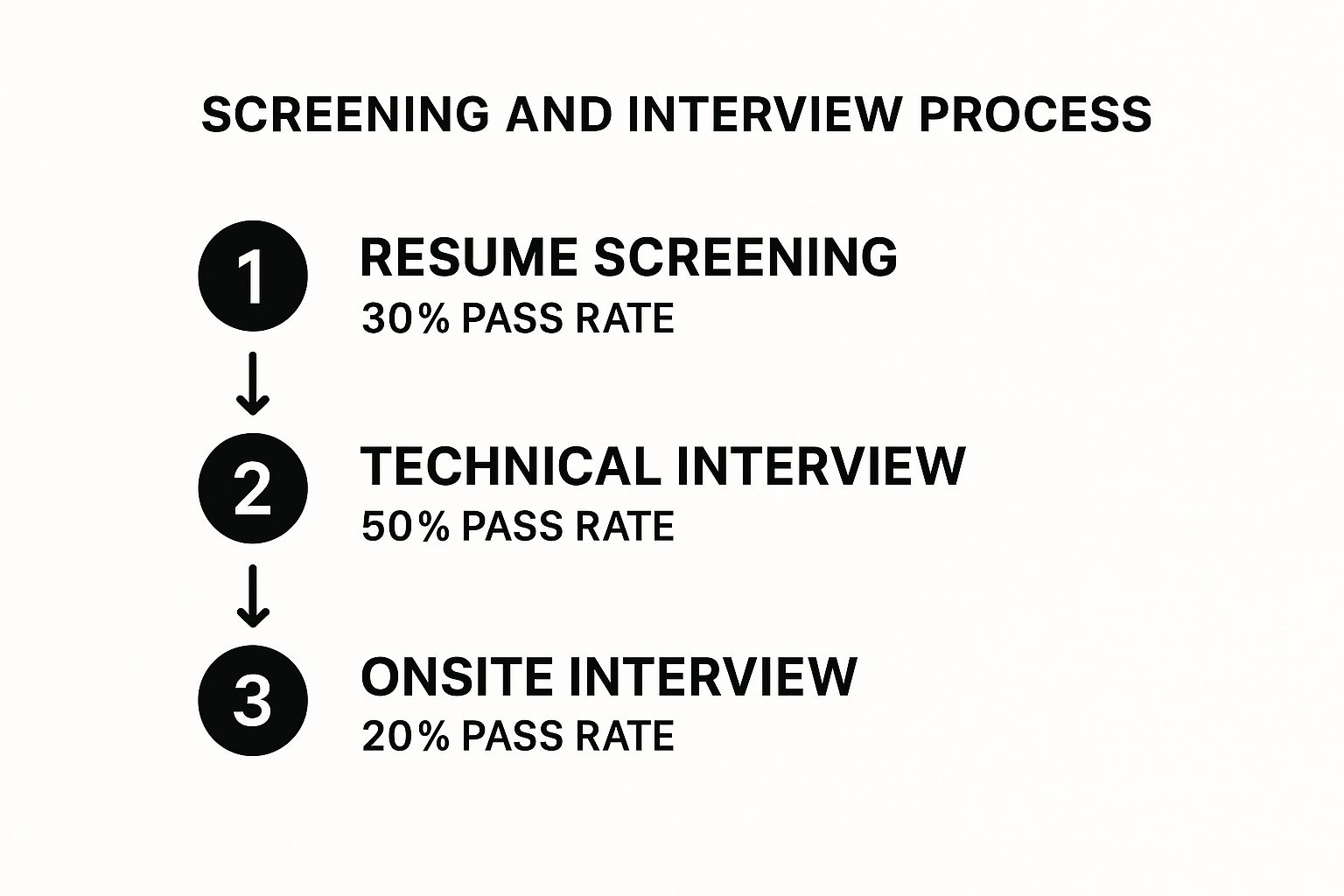
The big takeaway here? A rigorous, multi-stage process is your best tool for filtration. If designed correctly, only the top 20% of candidates who clear the technical interview should even make it to the final stage. This is how you focus your team’s most valuable time where it truly matters.
Key Stages for Effective Evaluation
A modern interview process usually has a few non-negotiable parts, each testing a different facet of a developer’s abilities.
Practical Take-Home Assignment: Ditch the whiteboard puzzle for good. Instead, give candidates a small, clearly defined project that looks a lot like something they’d actually work on. You’re not looking for perfection; you’re looking at their thought process, their coding style, and how they handle requirements.
Technical Deep-Dive on Past Projects: This is pure gold. Ask them to walk you through a project they're genuinely proud of. It’s a window into how they navigate complexity, make difficult trade-offs, and explain their decisions. It’s the closest you can get to seeing their real-world experience in action.
System Design Interview: For senior or principal roles, this is a must. Present a high-level architectural problem and let them design a solution. This isn't about code—it's about their ability to think strategically about scale, performance, and long-term maintainability.
The most insightful interviews feel more like collaborative problem-solving sessions than interrogations. The objective isn't to trip them up but to see how they think, communicate, and handle feedback when faced with a complex challenge.
Training Interviewers and Minimizing Bias
Your interview process is only as strong as the people running it. If your interviewers aren’t trained, they’ll inevitably fall back on "gut feelings" or introduce unconscious bias, causing you to pass on incredible talent from different backgrounds.
Give your team a structured set of questions and a clear rubric for what "good" actually looks like. Standardization is your best defense against bias, ensuring every candidate gets evaluated on the same playing field. For a much deeper dive, we’ve put together a guide on navigating the software engineer interview process with more practical tips.
To build out a process like this, it’s helpful to see what a modern interview funnel looks like from a high level.
Effective Interview Stage Breakdown
Interview Stage | Primary Goal | Key Evaluation Criteria |
|---|---|---|
Initial Screen (Recruiter) | Assess baseline fit, interest, and communication skills. | Career goals, salary expectations, understanding of the role, clarity. |
Take-Home Challenge | Evaluate practical coding skills and problem-solving approach. | Code quality, test coverage, solution design, adherence to requirements. |
Technical Deep-Dive | Understand real-world experience and technical depth. | Ability to articulate past decisions, ownership, handling complexity. |
System Design / Architecture | Gauge strategic thinking and ability to build for scale. | Scalability, reliability, trade-off analysis, clarity of thought. |
Final "Culture" Interview | Ensure alignment with team values and collaboration style. | Teamwork, communication, curiosity, motivation, handling feedback. |
This structure ensures you’re not just testing for one skill but building a complete picture of the candidate.
Ultimately, a world-class candidate experience is a massive competitive advantage. When you treat people with respect and design an interview that genuinely assesses their talent, you don’t just make better hires—you build a reputation that attracts the best engineers, even when you can’t outspend the competition.
Going Global With Staff Augmentation
Hiring top software developers from around the world gives you a massive competitive advantage. That much is obvious. But the logistics? They can be an absolute nightmare.
Figuring out international compliance, payroll, and benefits across different countries is a complex, time-consuming mess. This is exactly where an emerging trend in workforce management—specifically, a new kind of staff augmentation—changes everything.
Forget what you know about traditional temp staffing. This is a strategic way to build a resilient, global team by embedding world-class developers directly into your projects, but without the soul-crushing overhead of direct international hiring.
A Smarter Way to Build Your Team
The core idea is simple: get access to a global talent pool at a price that makes sense. Instead of getting boxed in by your local market’s sky-high salaries and cutthroat competition, you can find developers with incredible niche skills in places where the cost of living is lower.
This isn't about cutting corners; it's about being smart with your resources. The benefits are impossible to ignore:
Serious Cost Savings: Tapping into global talent can slash your labor costs by up to 60%. Imagine what you could do with that extra budget—like hiring even more top-tier engineers.
Access to Niche Skills: You can finally find those experts in specific technologies or industries that are just plain missing from your local area.
Real Agility: Need to scale your dev team up for a big push or dial it back after a launch? Now you can, without the long-term baggage of permanent hires.
The real magic of this model is how it blends affordability with deep expertise. You get the flexibility of a contractor with the dedicated focus of an in-house team member, all while a partner handles the brutal administrative work behind the scenes.
How It Actually Works
A Talent-as-a-Service (TaaS) platform is the engine that makes this possible. Think of platforms like Shorepod as your global HR and logistics department, managing the entire lifecycle of your international hires. They handle everything from sourcing and vetting to onboarding and payroll.
For any company that wants to recruit software developers from across the globe without becoming an expert in international HR law, this is a total game-changer.
The platform takes care of all the headaches so you can focus on what actually matters: managing the work and building amazing products. This includes the nitty-gritty stuff like:
Global Payroll and Benefits: They manage compensation and benefits that are fully compliant with local laws in each developer’s home country. No guesswork required.
Compliance and Legal: All employment contracts and practices are buttoned up to meet regional legal standards, which seriously reduces your risk.
Seamless Integration: They make sure new talent feels like a genuine part of your team from day one, giving them the tools and context they need to hit the ground running.
By wiping these administrative hurdles off your plate, the TaaS model opens up access to a worldwide talent pool for companies of all sizes. If you want a deeper dive, you can unlock growth with staff augmentation services in our full guide.
Ultimately, it’s about building a cohesive, productive, and truly global team that gives your company a real, sustainable edge.
Still Have Questions About Recruiting Software Developers?

As you start putting your recruiting strategy into action, a few questions always seem to bubble up. Let's tackle some of the most common hurdles hiring managers face today and get you some clear, no-nonsense answers.
Why Is a Slow Hiring Process So Damaging?
To put it bluntly, a lengthy hiring process is the silent killer of great recruiting. Top software developers are a hot commodity; they don't stay on the market for long. When your process drags on for weeks—or even months—you're not just creating a frustrating experience. You're actively losing the best people to your more decisive competitors.
Think about it from their perspective. Every extra day you take is another day for them to get a competing offer. Long delays signal inefficiency and can make your company seem disorganized or, worse, uninterested. In this market, speed is your biggest advantage.
How Can We Assess AI Skills Without Internal Experts?
This is a big one, especially as AI becomes a non-negotiable part of the dev toolkit. If your current team doesn't have a deep bench of AI experts, don't panic. The key is to shift your focus from assessing perfect, pre-existing knowledge to evaluating a candidate’s problem-solving process and their raw ability to learn. This aligns with the broader trend of prioritizing adaptability amidst rapid advancements in technology.
Here’s a practical way to do it:
Give them a real-world problem. Present candidates with an actual AI-related challenge your business is facing. Ask them to walk you through how they’d approach it, the tools they’d consider, and how they would even begin to measure success.
Drill down on the 'how'. Pay close attention to their thought process. Are they asking sharp, insightful questions? Can they articulate the trade-offs between different AI models or methodologies? Their ability to reason through an unfamiliar problem is far more valuable than knowing a specific algorithm off the top of their head.
The goal isn't to find someone who already has all the answers. It's to find the person who shows the curiosity and analytical grit to figure them out.
Isn't Staff Augmentation Just for Short-Term Projects?
That used to be the case, but the game has changed. While traditional staff augmentation is great for plugging temporary gaps, its modern evolution—Talent-as-a-Service (TaaS)—is built for the long haul. TaaS is an emerging trend in workforce management focused on creating stable, deeply integrated extensions of your core engineering team with world-class global talent.
This shift isn't happening in a vacuum. The talent landscape is brutal. Recruitment teams are under immense pressure, with a staggering 51% of organizations saying turnover within their own recruiting department is their biggest challenge heading into 2025. On top of that, 42% report that the sheer competition makes hiring developers significantly harder. These pressures are pushing smart companies toward more sustainable, flexible models like TaaS. You can dig into more of these recruiting statistics on selectsoftsoftwarereviews.com.
Using a TaaS platform gives you access to dedicated, long-term developers who become true members of your team, embedded in your projects and your culture. It's the stability of a permanent hire combined with the flexibility and cost-effectiveness of a global, contingent labor model. This is how you build resilient, scalable engineering teams today.
Ready to access a global pool of pre-vetted, elite software developers? Shorepod offers a new kind of staff augmentation, providing the most affordable way to build your dream engineering team. Get started with Shorepod today.
Comments