How to Outsource Software Developers the Right Way
- Ron Smith

- Oct 24
- 18 min read
Let's get one thing straight: the old way of outsourcing is dead. If you still think of it as a simple cost-cutting trick, you're already behind.
In this guide, we’ll not only cover proven methods to outsource software developers effectively, but also dive into emerging trends in workforce management, the rise of contingent labor, and the AI-driven advancements transforming staff augmentation into a strategic advantage.
Today, smart companies outsource software developers not just to save a few bucks, but as a core strategy to tap into a global talent pool, innovate faster, and build a more resilient, competitive team. It's about embedding vetted global experts into your core operations, not just finding temporary help.
The New Rules of Outsourcing Software Talent

The traditional view of outsourcing—find the cheapest labor possible—is a broken model. In today's market, that mindset is a fast track to mediocrity. Outsourcing has evolved from a tactical budget fix into a fundamental part of a forward-thinking growth strategy. This evolution also reflects a shift toward integrated workforce management and contingent labor models, where teams blend full-time roles with on-demand specialists to stay agile.
What’s driving this? A massive shift toward a more flexible, on-demand workforce. It's not just about hiring a freelancer for a quick gig. It's about building an agile team that can pivot the moment the market does. Companies that get this right are the ones winning.
Adopting a Global Talent Strategy
This means you need to start thinking like a global talent strategist. The world is your hiring pool. Stop fighting over the same handful of senior engineers in your city and start looking for specialized expertise wherever it exists. Modern staff augmentation is about finding the right talent, not just the cheapest talent.
Here's what that actually looks like in practice:
Access to Vetted Experts: You partner with platforms that do the hard work of vetting developers for you. This takes the risk and guesswork out of hiring someone from halfway across the world.
Strategic Skill Integration: You’re not just offloading grunt work. You’re bringing in specialists who offer fresh perspectives and skills your current team might be missing, sparking real innovation.
Focus on Long-Term Value: The goal is to build stable, lasting relationships. This cuts down on the constant churn and knowledge drain that comes with short-term, project-based gigs. To really get a handle on this, check out our guide on the advantages and risks of outsourcing for tech leaders.
The Role of AI in Modern Workforce Management
Of course, technology—especially AI—is a huge part of this shift. Modern workforce management is being revolutionized by AI-driven platforms that automate administrative tasks and deliver predictive insights. These platforms are also central to emerging contingent workforce management systems that optimize scheduling, compliance, and performance at scale. They give you real insight into how your team is performing, all without making you feel like a micromanager.
Today’s tech lets you manage international teams seamlessly. Everything from interviewing and onboarding to payroll and time tracking can be handled through one smart platform. This is the new staff augmentation—smarter, more efficient, and way more affordable.
When you outsource software developers with this new mindset, you're doing more than just hiring a coder. You're building a future-proof organization—one that's resilient, geographically diverse, and packed with top-tier talent.
Defining What You Actually Need
Jumping into the search for outsourced developers before you know exactly what you're building is a classic mistake. It’s like starting a road trip without a map—you'll end up somewhere, but almost certainly not where you planned. The first, most critical step is an honest internal audit to get a crystal-clear picture of your project.
This means defining the scope, nailing down the technical requirements, and, most importantly, outlining what success actually looks like. A vague idea of "we need a new app" is a surefire way to get mismatched talent. A detailed brief, on the other hand, acts as a magnet for the right people. And before you commit to building anything, it’s always worth considering the fundamental build vs. buy decision to make sure outsourcing is even the right move.
From Vague Idea to Actionable Blueprint
To get this blueprint right, you need to hammer out three core areas:
Project Goals and Scope: What business problem is this solving? Who are you building it for? What are the absolute must-have features for version one, and what can wait?
Technical Stack: Get specific. List the exact programming languages, frameworks, databases, and cloud services you need. This is non-negotiable for finding someone with the right skills.
Team Composition and Seniority: Do you need a single senior architect to lay the foundation, or would a pair of mid-level engineers get you to market faster? Define the roles and experience you need upfront.
A great project brief does more than list technical specs. It tells a story. It explains what you're trying to build and why it matters. This context is what gets the best developers genuinely excited and invested in your mission from day one.
A detailed brief ensures you’re not just hiring a coder, but a strategic partner who actually understands your vision. For more on this, check out our guide on how to create job descriptions that attract top talent for a deeper dive into crafting compelling roles.
A Real-World Fintech Scenario
Let’s walk through a real-world example. Imagine a fintech startup that needs to build a secure payment gateway. Their immediate goal is to launch an MVP within six months to lock in their next round of funding.
A vague request for "backend developers" would unleash a tidal wave of totally wrong applicants. So instead, they sit down and create a precise brief.
Project Breakdown:
Backend Development: They need a rock-solid, scalable backend to handle transactions. The team has already decided on Java with the Spring Boot framework for its security features and performance. The brief specifies a need for a developer with proven experience building financial systems.
DevOps and Infrastructure: The platform has to live on AWS, which means they need someone who knows services like EC2, RDS, and S3 inside and out. A key requirement is setting up an automated CI/CD pipeline for fast, reliable deployments.
The Seniority Debate: Now for the classic dilemma: hire one senior architect or two mid-level engineers? * The Architect: A senior dev could design the entire system beautifully but might become a bottleneck when it’s time to actually write the code. * The Mid-Level Duo: Two mid-level developers could crank out code faster but might lack the high-level vision, potentially creating technical debt down the line.
After looking hard at their aggressive timeline and tight budget, they make a strategic call. They’ll hire one senior Java/Spring developer and one mid-level DevOps engineer. This gives them the architectural leadership to build a solid foundation while ensuring the infrastructure keeps up, putting them on the fast track to a successful MVP launch.
Choosing Your Outsourcing Partner and Model
This is it. This is the single most important decision you'll make when you outsource software developers. Get this right, and you’re golden. Get it wrong, and you’re in for a world of headaches.
Too many companies stumble right here. They either chase the lowest price tag or pick a model that’s completely misaligned with their actual goals. You have to look past the buzzwords and really understand what each option means for your control, your budget, and your team's day-to-day reality.
Are you plugging a temporary skills gap for a few months? Or are you building a long-term extension of your engineering team? The answer changes everything.
Understanding Modern Outsourcing Models
Let's be clear: the old way of outsourcing—tossing a project over the wall and hoping for the best—is dead. Today’s models are far more integrated and strategic. The new wave of staff augmentation, for instance, isn’t about hiring disconnected freelancers. It's about embedding pre-vetted, world-class developers directly into your team.
This decision tree helps visualize how your project needs point you to the right talent.
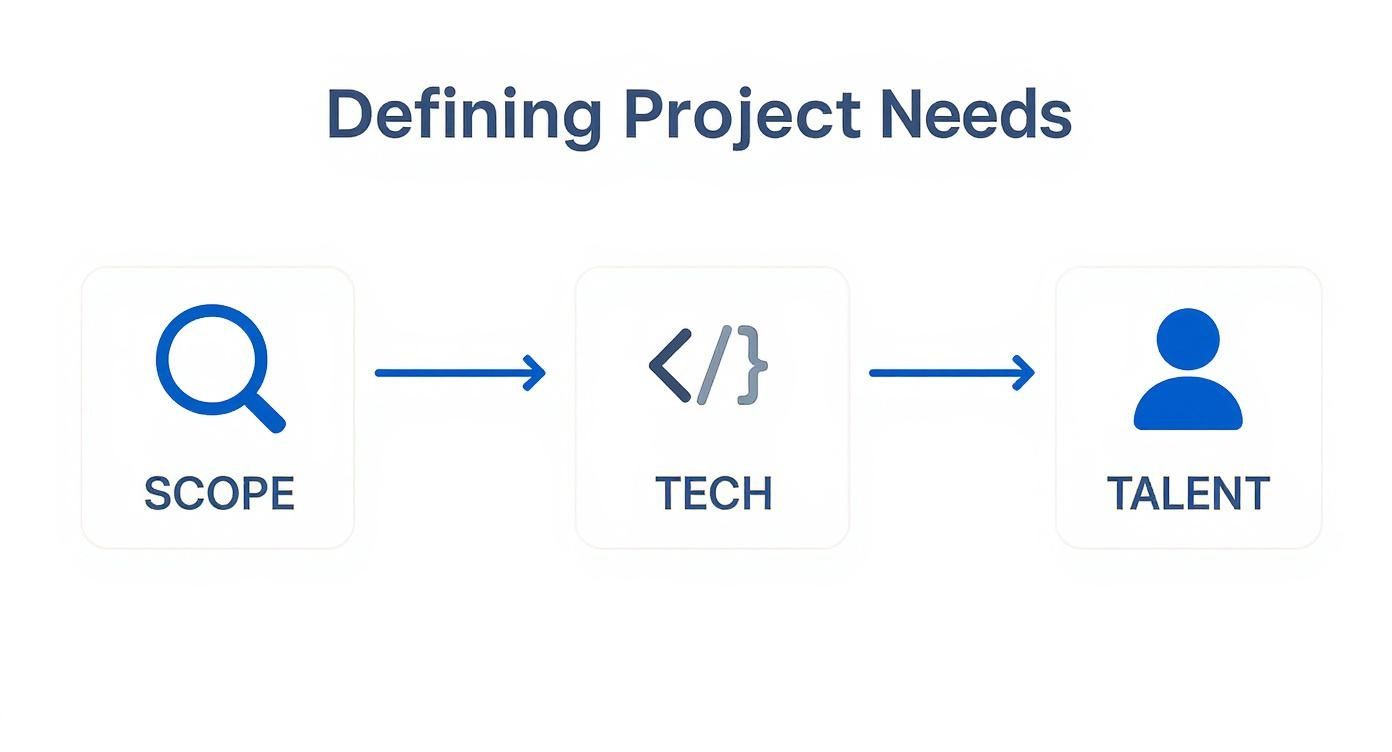
As you can see, the project's scope and the tech stack you're using are the first dominos to fall. They directly dictate the kind of talent and engagement model that will set you up for success.
So, let's break down the three main models to see how they actually play out.
The right model really depends on how hands-on you want to be and the nature of your project. This table lays out the core differences.
Comparison of Software Outsourcing Models
Model | Level of Control | Cost Structure | Best For |
|---|---|---|---|
Staff Augmentation | High: Developers integrate directly into your team, reporting to your managers. | Monthly Rate: You pay a fixed monthly fee per developer. | Quickly filling skill gaps, scaling your team with specific expertise, and maintaining direct oversight of the development process. |
Dedicated Team | Medium: A managed team works exclusively on your projects, but with a partner-provided project manager. | Monthly Team Rate: A blended rate covering all team members, management, and overhead. | Long-term projects requiring a full, self-contained team without the burden of day-to-day management. |
Project-Based | Low: You define the scope and deliverables; the partner manages the entire project. | Fixed Price: A set cost for the entire project, agreed upon upfront. | Well-defined, short-term projects with minimal changes expected, where you can offload the entire development lifecycle. |
Each has its place, but one is clearly pulling ahead for companies that want both quality and control.
The New Wave of Staff Augmentation
While all these models have merit, a new flavor of staff augmentation is changing the game. We call this our next-gen contingent labor model: global talent on-demand, managed end-to-end, at the most affordable cost. It’s hands-down the most effective and affordable way to get top global talent on your team.
We're not talking about temporary help from a freelance marketplace. This is a strategic play. It involves bringing on vetted, full-time developers who become genuine members of your team, managed through a single platform. It’s designed for leaders who want the integration of a direct hire without the months of recruiting and administrative overhead.
Critical Questions for Potential Partners
Finding the right partner is about more than just slick portfolios and case studies. You need to get under the hood and understand their process, their culture, and their tech.
Don't sign anything until you get solid answers to these questions:
Talent Vetting and Recruitment: "Walk me through your exact vetting process. How do you test for hard skills, and more importantly, how do you screen for communication, problem-solving, and cultural fit?"
Talent Retention Rates: "What's your average developer retention rate? What are you actively doing to keep your best people from walking out the door?"
Use of AI and Technology: "How are you using AI in your own platform to make things like project management, communication, and performance tracking easier? Show me."
Cultural and Logistical Alignment: "How do you prep your developers to work with a team in our time zone? What support do you provide to make sure there are no cultural or communication roadblocks?"
Your outsourcing partner isn’t just a vendor. They’re an extension of your company. Their ability to find, keep, and manage great people will directly impact the quality of your product. High retention rates aren’t a vanity metric; they’re proof of a healthy environment that top developers actually want to be a part of.
The Impact of Geography
The decision between hiring in Eastern Europe versus Latin America isn't just about the hourly rate. It has a massive impact on your team’s daily rhythm.
A partner in Latin America gives you huge time-zone overlap with U.S. teams, which makes real-time collaboration feel effortless. On the other hand, a team in Eastern Europe can be perfect for a "follow-the-sun" model where your development cycle never stops.
Cultural alignment is just as important. A great partner gets this. They actively work to build a single, cohesive team culture that erases geographical lines. This isn't just a nice-to-have; it's a game-changer. Done right, outsourcing can slash project costs by up to 40% and, in some cases, speed up delivery by 50%. You can explore the full impact of outsourcing on project timelines and budgets in recent industry data.
Ultimately, picking the right partner and model builds confidence. It transforms your team from a local crew into a global powerhouse, giving you a serious competitive edge.
Integrating and Managing Your Remote Team
So you’ve found your developers. The contracts are signed. Now what? The real work begins—weaving them into the fabric of your company so they feel less like hired guns and more like part of the core crew.
Forget the hands-off approach. You need a rock-solid onboarding plan that immerses them in your culture from day one. It’s not about just handing over a login. It's about creating a sense of belonging, fast.
We've seen clients have huge success with simple things, like sending a welcome kit packed with company swag and a printout of the team's core values. It's a small touch that makes a big difference.
A few other things that work wonders:
Assign a "buddy" for the first month. This gives new hires a go-to person for all the "stupid" questions they're afraid to ask in a group channel.
Create a "team wiki" or shared doc. This should be the single source of truth for workflows, communication norms, and what success actually looks like.
Schedule a casual video call in the first week. No agenda, just a virtual coffee to break the ice and put faces to names.
Nail Your Communication Rhythm
For any remote team, communication is the engine. If it sputters, everything grinds to a halt. You need to be intentional about how you talk.
Set up dedicated Slack channels for specific projects, general Q&A, and even social chatter. This keeps conversations focused and easy to find. We’re also big fans of asynchronous stand-ups in a shared thread—all the updates, none of the meeting fatigue.
Getting your communication practices right isn't just a nice-to-have. We've seen industry reports show it can boost remote productivity by as much as 25%.
Bridge the Cultural Divide
When your team spans multiple continents, you can’t just ignore cultural differences and hope for the best. Building trust means showing you respect and understand their world.
It doesn’t have to be complicated. Try a biweekly "culture hour" where team members share local traditions or holidays. You’d be surprised how much empathy a simple conversation can build.
Also, consider these practical steps:
Translate key documents into the team's native language if there’s a significant barrier.
Acknowledge and celebrate international holidays. It shows you see them as more than just a resource.
Rotate meeting times so the same people aren't always stuck with the late-night or early-morning call.
Keep a Pulse on Performance (Without Micromanaging)
This is where things get interesting. Modern AI-driven tools are completely changing how we manage remote talent.
Platforms that analyze code quality, flag potential bottlenecks, and track progress against deliverables give you incredible visibility. The goal isn't to spy on your team; it's to stay informed so you can offer support where it's needed most. You get to focus on strategy while the tech handles the routine checks.
Use automated QA tools to catch inconsistencies in code before they become a problem.
Lean on project management dashboards for a real-time view of sprint progress.
Deploy AI chatbots to answer common process questions, freeing up your managers for more strategic work.
Real-World Example: Making It Work Across 10 Time Zones
We worked with a client who brought on a team in Latin America, a full 10-hour time difference from their core staff. They were worried it would be a logistical nightmare.
Using this exact playbook, they got the new developers onboarded and shipping code in under two weeks. They established weekly syncs with rotating times to be fair to everyone. Within a month, the new hires said they felt like a genuine part of the internal team, not outsiders.
The results speak for themselves:
Onboarding time was cut by 60% thanks to a templated, repeatable process.
Cross-team bugs dropped by 30% after they started using AI-powered code reviews.
A survey showed employee engagement jumped by 15% once they introduced regular virtual social events.
Want to go deeper on this? We've put together a whole guide on the best ways to lead distributed teams. Check out our post on A Guide to Managing Offshore Development Teams.
Creating Rituals That Actually Stick
One-off events are nice, but consistent, repeatable rituals are what truly anchor a remote team. They create a predictable rhythm and a shared sense of identity.
Think about introducing things like monthly virtual hackathons. Give your developers a day to just build something cool together, with no pressure.
Here are a few other rituals that have a huge impact:
Weekly Demo Days: Let each developer show off what they’ve built. It’s great for morale and keeps everyone in the loop.
Peer Code Reviews: This isn't just about quality control. It's a powerful way to share knowledge and build relationships.
Quarterly Retrospectives: Create a safe space to talk about what’s working, what isn’t, and how to improve as a team.
Set Clear Goals and Remote-Friendly KPIs
For a remote team, success has to be about outcomes, not hours spent at a keyboard. Clear, measurable goals give developers the autonomy they need to do their best work.
When everyone can see the key metrics, it fosters a sense of ownership.
Sprint velocity is your classic measure of team pace.
Code review turnaround time tells you a lot about collaboration and responsiveness.
Production incident count is a direct reflection of code quality and reliability.
The Right Tools Make All the Difference
Don't make your managers juggle a dozen different platforms. A unified toolset reduces friction and saves a ton of time.
AI is also becoming a manager’s best friend. Tools that offer suggestions directly in pull requests can catch issues early and drastically reduce review time.
GitHub Copilot can feel like a superpower, automating boilerplate code and speeding up the entire development flow.
Jira dashboards bring all your sprint metrics and backlogs into a single, easy-to-scan view.
Slack integrations can push real-time alerts for build failures or production incidents right where the team is already talking.
The Bottom Line: It’s All About Intentionality
Effectively integrating outsourced developers doesn't happen by accident. It's the result of a deliberate strategy that combines structured onboarding, clear communication, and smart tools.
Get this right, and you’re not just hiring temporary help. You’re building a high-performing, deeply committed extension of your core engineering team.
By following these practices, you can outsource software developers without ever compromising on quality, culture, or momentum.
Never Stop Improving
The most successful teams are the ones that are always learning. Build a continuous feedback loop to keep refining your processes.
Collect anonymous feedback regularly to get the unvarnished truth.
Update your onboarding checklist every quarter based on what new hires tell you.
Iterate constantly. What worked six months ago might not be the best approach today.
Navigating the Global Talent Landscape

Deciding where you outsource software developers isn't just a simple cost-cutting exercise anymore. It's a strategic move that defines your project's success, your team's chemistry, and your ability to innovate. The right location gives you more than a good hourly rate; it delivers a specific mix of technical chops, cultural alignment, and logistical sanity.
Let's be clear: not all outsourcing hubs are the same. Each region has carved out its own niche, shaped by different education systems, economic policies, and tech communities. The smart play is to be precise—find the exact skills you need in the market that's famous for them.
Eastern Europe: The Technical Powerhouse
For a while now, Eastern Europe has become the go-to for complex, mission-critical software projects. Countries like Poland and Ukraine aren't just churning out code; they're producing serious engineering talent with deep roots in mathematics and computer science.
This region absolutely shines when it comes to sophisticated problem-solving. If your project is heavy on complex algorithms, data science, or bulletproof backend architecture, you can’t go wrong here.
Core Strengths: Deep expertise in AI, machine learning, blockchain, and fintech. Engineers here are known for writing clean, structured code and taking a methodical approach.
Cultural Fit: Developers often have a direct, no-nonsense communication style that clicks perfectly with most Western teams.
English Proficiency: Typically excellent, especially in the tech scene, which smooths out communication from day one.
The only real catch? Costs can be a bit higher than in some Asian markets. But you’re not just paying for a developer; you're paying for a specialist.
Asia: A Hub of Scale and Diversity
You can't talk about outsourcing without mentioning Asia. Powerhouses like India and Vietnam are still major forces. India, in particular, remains a massive player, but the field is getting more diverse. While India is projected to hold a 17.6% share of the global market in 2025, the Philippines is right there with 13.5%.
What's really shifted the dynamic is Eastern Europe, with countries in the region now collectively accounting for nearly 40% of the global market. The rise has been rapid. You can read the full research about these global market shares to see just how much the landscape has changed.
The biggest advantage of Asia is still its incredible scale. You can find developers for just about any tech stack imaginable, often at the most competitive rates on the planet.
Don't make the mistake of thinking lower cost means lower quality. It all comes down to finding the right partner. A well-vetted team in Asia can deliver incredible value, especially for large-scale enterprise apps, mobile development, and QA testing.
Latin America: The Nearshore Advantage
For any company based in North America, Latin America is a game-changer. Countries like Brazil and Argentina are producing a new generation of skilled, creative developers who are eager to work on interesting projects.
The killer feature here is time-zone alignment. Being able to collaborate in real-time—without forcing someone on your team to take a 3 a.m. call—is a massive win for productivity and morale.
Key Specialties: The region has a fantastic reputation for creative front-end work, UI/UX design, and modern JavaScript frameworks like React and Node.js.
Collaboration: The minimal time difference makes your outsourced developers feel less like a separate team and more like they’re just in the office next door.
Cost-Effectiveness: While it might not be the absolute cheapest option, Latin America hits a sweet spot between cost, talent, and pure convenience. It’s a top-tier choice for modern staff augmentation.
At the end of the day, the "best" region is the one that fits your project's DNA. The goal is to build a distributed team that plays to the unique strengths of each global talent hub, giving you a powerful edge.
The Future of AI-Driven Talent Management
Let's be honest, the old conversation about how to outsource software developers is dead. It’s no longer about just finding a warm body to fill a seat. We’re in a new game now—building smart, agile, and globally distributed teams.
This whole shift is being supercharged by a new breed of staff augmentation, one that fuses affordable global talent with some seriously powerful AI management.
We're seeing new AI tools that are completely changing how we build and manage these teams. They're doing way more than just tracking tasks; they're giving us predictive analytics that can flag a potential project delay weeks before it becomes a fire drill. This isn't a "nice-to-have" anymore. It's the new benchmark.
AI Enhanced Sourcing and Oversight
AI is making the hiring process ridiculously fast and intelligent. We're talking about sophisticated algorithms that can sift through massive talent pools and pinpoint developers with the exact hard and soft skills you need. This isn't just theory; it's cutting down the time to find a perfect match from months to days.
If you want to go deeper on how this tech is shaking things up, check out the role of AI in recruiting.
But the value doesn't stop once you've hired someone.
Automated Oversight: Imagine AI tools monitoring code quality and project velocity in the background. No more constant manual check-ins. This frees up your managers to actually focus on high-level strategy instead of micromanaging pull requests.
Predictive Analytics: By chewing through project data, these systems can see around corners. They'll forecast potential bottlenecks, giving you a chance to get ahead of problems before they derail your timeline.
Seamless Integration: The best platforms handle everything from payroll and compliance to performance tracking. It makes managing an international team feel surprisingly simple and buttoned-up.
You can see this evolution reflected in the market's insane growth. The global IT and software outsourcing market is on track to blow past $800 billion USD by 2029. What's driving it? The insatiable demand for specialized talent that can be sourced from anywhere on the planet.
Jumping into this new era of AI-enhanced staff augmentation isn't just a smart move—it’s a survival tactic. It's hands-down the most affordable and effective way to build the global dream team you need to compete.
Your Questions, Answered
Thinking about bringing on contingent labor always kicks up a few questions. It’s a big move, and you need straight answers before you dive in. Here are some of the most common things leaders ask when they're getting ready to outsource software developers.
How Do I Protect My Intellectual Property?
This one is non-negotiable. Don't even think about starting work until you have a rock-solid Non-Disclosure Agreement (NDA) and an Intellectual Property (IP) Assignment Agreement signed.
Any reputable staff augmentation partner will have these protections baked right into their standard contracts. It's a foundational part of the process, ensuring that every line of code and every piece of proprietary information belongs to you and you alone. Security isn't an afterthought; it’s built in from day one.
Is It Expensive To Outsource Software Developers?
It can be, but it doesn't have to be. The new wave of staff augmentation flips the cost equation on its head.
By tapping into global talent pools in places with a lower cost of living, you can bring on world-class engineers for a fraction of what you’d pay in a major tech hub. On top of that, AI-driven platforms are cutting out the expensive administrative and management overhead, making this one of the most affordable ways to build a truly exceptional team.
How Does AI Improve The Outsourcing Process?
AI is a game-changer for managing global teams. Instead of sifting through résumés for weeks, AI-powered platforms can source, vet, and match candidates with a level of speed and precision that humans just can't replicate.
Once they're on the team, these systems give you a real-time pulse on project velocity and code quality without you ever having to micromanage. They can even provide predictive insights to flag potential delays before they become problems. It makes the whole process of managing contingent developers smarter, more efficient, and completely data-driven.
What Is The Best Outsourcing Model For Startups?
For startups and most mid-size companies, modern staff augmentation hits the sweet spot. It offers the perfect blend of control, flexibility, and cost-efficiency.
You get to hand-pick pre-vetted developers who become a real part of your team. They integrate into your existing workflows, adopt your company culture, and report directly to you. This lets you drive the project vision while completely side-stepping the sky-high costs and long-term baggage of traditional hiring.
Ready to build your global dream team without the usual headaches? Shorepod offers this new kind of staff augmentation, combining pre-vetted global talent with an AI-powered management platform at the most affordable cost. Discover the future of workforce management and contingent labor at https://www.shorepod.com.
Comments