sample termination letter for contractors: Templates
- Ron Smith

- Nov 18
- 13 min read
When it's time to part ways with a contractor, the termination letter is your final, official handshake. This isn't just a formality; it's a critical document that needs to clearly state the contract's end date, reference the specific agreement you're closing out, and lay out the logistics for final payments and returning company property.
Getting this right keeps the relationship clean and legally sound.
Why Smart Contractor Offboarding Matters Now

Ending a contractor relationship is a normal part of business, especially when you’re managing a flexible, modern workforce. It’s not a failure—it's a strategic process that demands care and precision. As more companies lean on a global pool of contingent talent, a polished and professional offboarding process has become more important than ever.
A smooth exit protects your business from potential legal blowback and safeguards your professional reputation. Think about it: every interaction, including the very last one, says something about your brand. A botched termination can burn bridges, tarnish your employer brand, and open you up to unnecessary legal headaches.
The Shift to Strategic Workforce Management
Today’s teams are a dynamic blend of full-time employees and specialized contractors. This model, often called staff augmentation, is a game-changer, letting companies tap into global talent and scale on a dime. But this flexibility comes with its own set of challenges, especially around compliance and offboarding.
We're seeing a clear shift toward using technology to manage this new workforce dynamic. An emerging trend is the integration of AI-driven platforms, which are no longer a "nice-to-have"—they're becoming essential for handling the entire contingent labor lifecycle, from onboarding to the final termination letter. These systems help ensure your offboarding is efficient and compliant with a patchwork of international labor laws.
A well-executed offboarding is your final opportunity to show professionalism and respect. It solidifies the terms of separation, minimizes legal risks, and helps maintain a positive connection with talent you might want to work with again.
A New Approach to Global Talent
At Shorepod, we're on the front lines of this new era of workforce management. We champion a new kind of staff augmentation that connects companies with premier global talent at the most affordable cost. Our platform is built to handle the complexities of managing international teams, and that includes compliant offboarding. We make sure that when a project wraps up, the process is seamless for both you and the contractor.
While the rules for terminating employees are different, you can still get valuable insights from our essential employee termination process checklist for broader best practices.
This guide will give you the tools to handle contractor terminations with confidence. Before we dive into the templates, let's break down the essential pieces of any effective termination letter with a quick-reference table.
Key Components of an Effective Contractor Termination Letter
This table summarizes the must-have elements for any contractor termination letter. Think of it as your pre-flight checklist before sending that final email.
Component | Purpose | Why It's Critical |
|---|---|---|
Clear Statement | Directly state the termination of the contract. | Leaves no room for ambiguity or legal misunderstandings. |
Effective Date | Specify the exact date the termination takes effect. | Provides a clear timeline and honors any notice periods. |
Contract Reference | Mention the specific contract being terminated. | Links the letter directly to the governing legal agreement. |
Final Payment Details | Outline the amount and date of the final payment. | Ensures financial clarity and fulfills your contractual obligations. |
Property Return | Instruct on returning company assets. | Protects your company's physical and intellectual property. |
Nailing these components ensures your letter is professional, comprehensive, and legally sound, protecting everyone involved.
First Things First: Get Your Legal Ducks in a Row
Before you even think about drafting a termination letter, you have to get clear on the legal ground you're standing on. This is non-negotiable. Letting a contractor go is a whole different ballgame than firing an employee, and blurring that line can land you in hot water with misclassification risks and ugly legal penalties.
Your first move? Pull up the original signed agreement. That contract is your bible—it spells out everything, from required notice periods to the specific grounds for termination. In today's complex world of work, where advancements in contingent labor management are constant, you can't rely on memory or assumptions. It's a recipe for disaster. This isn't just about writing a letter; it's about following best practices for comprehensive contract management to make sure every step you take is defensible.
For Cause vs. For Convenience: Know the Difference
Contract terminations almost always fall into one of two buckets. Each requires a totally different approach.
Termination for Cause: This is what happens when a contractor doesn't hold up their end of the bargain. Think missed deadlines, work that’s not up to snuff, or breaking a confidentiality clause. If you're terminating for cause, your letter needs to be direct, to the point, and clearly reference the specific contract clauses that were violated.
Termination for Convenience: This is a no-fault situation. It's not about performance; it's about the needs of the business. Maybe the project wrapped up, budgets got slashed, or your company's strategy shifted. A well-drafted contract will have a clause that allows for this, which makes the whole offboarding process much cleaner.
Getting this distinction right is everything. Just look at the U.S. government—in fiscal year 2024, it terminated nearly 40,000 federal contracts for both convenience and default (their term for "cause"). But the process for each is worlds apart. A termination for convenience means you still have to pay for all the work that's been completed. A termination for cause, however, can have much bigger consequences for the contractor.
Common Reasons for Ending a Contract
The "why" behind the termination sets the entire tone and content of your letter. A letter for a finished project will sound completely different from one that’s addressing a breach of contract.
The reasons can get complicated, especially in certain industries. One deep-dive study in the construction sector found 42 different reasons for contract terminations, grouping them into things like Financial Difficulties, Client Defaults, and Contractor Shortcomings. Money issues, like budget shortfalls and poor cost planning, were huge drivers. It just goes to show how often these decisions are dictated by business realities, not just performance.
Your contract is the single source of truth. It defines the rules of engagement for the entire relationship, including how it ends. Never draft a termination letter without having it open right in front of you.
As more companies lean on a global, flexible workforce to get things done, getting these legal fundamentals right becomes even more critical. Every move you make has to be grounded in that contract to ensure a clean, professional, and compliant split that protects your business.
How to Draft a Clear and Compliant Termination Letter
Alright, let's get into the nitty-gritty of drafting the termination letter itself. The whole point here is to be direct, professional, and leave absolutely no room for confusion. Think of this letter as the final, official record of the relationship ending.
You have to start with a direct statement. No beating around the bush. Clearly state that the contract is ending and specify the exact date the termination takes effect. This sets a firm, unambiguous timeline and kicks off any notice period your contract requires.
Core Components of the Letter
A solid termination letter is built on a few essential pillars. Get these right, and you're creating a legally sound document that protects your business.
Reference the Governing Contract: Always call out the specific contract you’re terminating by name, including its title and the date it was signed. This formally tethers your letter to the correct legal agreement.
State the Reason (If Necessary): Terminating "for cause"? You have to spell out the specific reason and point to the exact contract clauses that were violated. But for "convenience" terminations, it’s usually best to keep it brief and professional without getting into the weeds.
Maintain a Neutral Tone: This is critical. The letter needs to be factual and stripped of any emotional language. A professional, neutral tone seriously minimizes the risk of the letter being misinterpreted or, worse, used against you in a legal dispute.
Before you even think about hitting 'send,' run through a quick legal check. This simple workflow is your safety net, making sure you've covered all your bases.
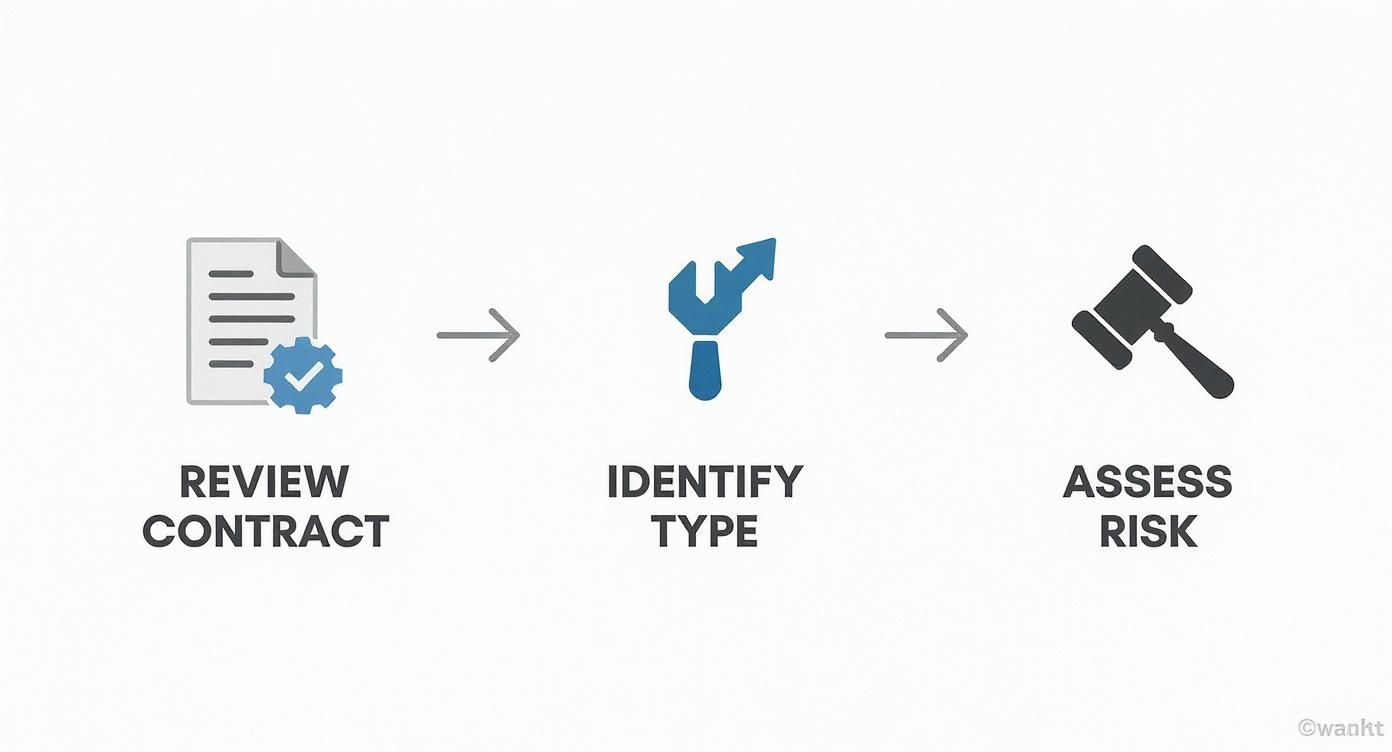
This kind of methodical approach stops you from making the common mistakes that happen when you rush to get a notice out the door.
Including Essential Logistics
Beyond the core legal statement, your letter needs to handle all the practical "housekeeping" items to ensure a clean break. Honestly, these logistics are just as important as the legalese.
Give crystal-clear instructions for the return of any company property. We're talking laptops, software licenses, ID badges, or any proprietary data. Set a hard deadline for when and how these items need to be returned.
You also need to detail the final payment arrangements. Specify the exact amount owed for outstanding work, the date it will be paid, and the payment method. Financial clarity here is your best defense against future disputes.
Don't forget to reinforce any ongoing obligations. Remind the contractor of their duties under existing Non-Disclosure Agreements (NDAs) or any confidentiality clauses that live on after the contract ends. This is a crucial step in protecting your intellectual property.
As workforce management evolves, so do the tools we use. An emerging trend in contingent labor management is the use of AI and automation to track and manage offboarding, ensuring every step is handled efficiently. This technological advancement has become a must-have for companies relying on global staff augmentation, providing a safety net of compliance and consistency. For a deeper look, check out our guide on drafting the perfect terminating services letter. It's a new way of managing talent that ensures even the end of a partnership is handled with precision and professionalism.
Dealing with International Contractor Terminations
When your team is spread across the globe, a cookie-cutter approach to offboarding contractors is a fast track to legal headaches. Letting go of international talent means stepping into a minefield of local labor laws, wildly different notice periods, and complex final payment rules. What’s perfectly legal in the US could land you in hot water somewhere else.
This isn't a niche problem anymore. As companies rely more on a global, distributed workforce, this kind of cross-border compliance becomes non-negotiable, especially during a sensitive process like a contract termination.
Why You Can't Ignore Local Laws
Overlooking the nuances of local laws isn't an option. What counts as a fair notice period in one country could be a serious legal violation in another. These aren't just minor details—they’re hard-and-fast rules with real financial penalties if you get them wrong.
Just look at the notice periods. In Latin America, Paraguay requires just 1 day of notice, but Peru demands a full 30 days for terminations without a specific cause. Head over to the Asia-Pacific region, and things can get even stricter—Vietnam requires at least 45 days' notice for indefinite contracts.
The differences are stark, and they prove why a generic termination letter just won't cut it. You can see just how much these notice periods vary by country and why localization is absolutely critical.
The biggest mistake you can make is assuming your home country's laws apply everywhere. Every single termination letter for an international contractor needs to be checked against local regulations. Getting this wrong can lead to costly legal fights and tarnish your company's reputation.
How Technology Helps with Global Compliance
Trying to manually keep up with constantly changing international laws is a massive, and frankly, unrealistic task for most teams. This is where technological advancements step in. Modern global talent platforms are built to de-risk the entire process of managing international contingent labor from start to finish.
These platforms act as a crucial safety net for your business. Leveraging AI and automation, they can:
Generate termination letter templates that are compliant with local laws.
Calculate final paychecks based on regional requirements.
Ensure you're meeting the statutory notice periods.
Handle the secure return of company equipment across borders.
This kind of tech support is essential for any company building a global team. By automating these complicated compliance checks, you can breathe easier knowing every offboarding is handled professionally, legally, and respectfully, no matter where your contractor is based. If you're just starting to build out your global team, it's worth getting a handle on what contingent workforce management is and how the right tools can make it all work.
Annotated Termination Letter Samples for Real Scenarios

Theory is one thing, but seeing how this plays out in the real world is where the rubber meets the road. I've put together a couple of annotated termination letters for common situations you'll almost certainly face.
Think of these less as templates and more as strategic documents. The annotations break down the "why" behind the language, showing you how to walk that fine line between legal clarity and professional tone. Use these to get comfortable drafting your own.
Sample 1: Termination for Convenience (Project Completion)
This is the best-case scenario. The project's done, everyone's happy, and you're wrapping things up. The goal here is to be professional, appreciative, and crystal clear, leaving the door wide open for future work.
Subject: Conclusion of Your Independent Contractor Agreement with [Your Company Name]Dear [Contractor Name],1. Formal Notice: This letter serves as formal notice that we are terminating your Independent Contractor Agreement, dated [Date of Original Agreement], for convenience.2. Effective Date: The termination will be effective as of [Last Day of Work], per the notice period outlined in Section [X.X] of our agreement.3. Final Payment: Your final invoice for all work completed through the effective date should be submitted by [Invoice Submission Deadline]. The final payment of [Amount] will be processed on or before [Final Payment Date].4. Company Property: Please return all company property, including [Laptop Model, ID Badge], by [Return Deadline].5. Acknowledgment: We want to thank you for your valuable contributions to the [Project Name]. We appreciate your hard work and wish you the best in your future endeavors.Sincerely,[Your Name/Company Representative]
Annotation Breakdown:
Items 1 & 2: Get straight to the point. Stating the termination is "for convenience" and providing a hard effective date removes all ambiguity. That kind of clarity is your best friend legally.
Items 3 & 4: These are the nuts and bolts. Giving specific, actionable deadlines for invoices and property returns prevents endless follow-up emails and potential disputes down the line.
Item 5: Always end on a high note if you can. In today's dynamic world of global talent networks and contingent labor, burning bridges is just bad business. You never know when you'll need a great contractor again.
Sample 2: Termination for Cause (Breach of Contract)
Okay, now for the tough one. When you're terminating for cause, the tone has to shift completely. You need to be firm, factual, and tether every single point back to the contract. Leave emotion at the door.
Subject: Notice of Termination of Independent Contractor Agreement for CauseDear [Contractor Name],1. Notice of Termination: This letter provides formal notice of the immediate termination of your Independent Contractor Agreement, dated [Date of Original Agreement].2. Reason for Termination: This action is taken for cause, pursuant to Section [X.X] of the agreement, due to a material breach of contract. Specifically, you have failed to meet the project deadlines outlined in Section [Y.Y] on [Date 1], [Date 2], and [Date 3], despite prior written warnings.3. Final Payment: As per the terms of the agreement, payment will be issued only for work completed and approved prior to the date of this notice.4. Obligations: You are reminded of your continuing obligations under Section [Z.Z] of the agreement, including the non-disclosure and confidentiality clauses.
Annotation Breakdown:
Item 2: This is the most critical piece of the whole letter. It doesn't just give a vague reason; it cites the specific contract section and provides a documented trail of the breaches. That specificity is your legal shield. Don't skip it.
Item 4: This is a vital step in protecting your company's IP after the relationship ends. You absolutely have to remind them that obligations like NDAs and confidentiality clauses don't just disappear when the contract does.
As you can see, a one-size-fits-all letter just doesn't work. The right language protects your business while reflecting the realities of managing a modern, flexible workforce.
Your Contractor Termination Questions, Answered
Let's be honest, ending a contractor relationship always brings up a few last-minute, nagging questions. Getting straight answers is the only way to move forward with confidence and make sure you're not creating a bigger problem down the road.
Let’s get into the most common things that come up.
What’s the Real Difference Between Terminating for Cause vs. Convenience?
Think of it as the "why" behind your decision. Terminating for cause is a direct response to a failure on their end—they’ve breached the contract. This isn't just a minor slip-up; it's things like repeatedly missing critical deadlines, delivering completely unusable work, or violating a confidentiality clause.
When this happens, your sample termination letter for contractors needs to be surgical. You have to document the specific breach and point directly to the clause in the contract they violated. No ambiguity.
Terminating for convenience, on the other hand, is a no-fault situation. The "why" here is all about your business needs. Maybe the project wrapped up early, your company is pivoting its strategy, or budgets got tightened. A well-written contract will have a dedicated clause for this, making the whole offboarding process a clean break.
Can a Contractor Actually Sue for Wrongful Termination?
Yes, absolutely. And they will if they feel you've given them a reason to. A contractor might go legal if they believe the termination breaks the rules of your agreement, if it feels discriminatory, or if you failed to give them the notice period you both agreed to.
Your best defense is always a rock-solid paper trail and a termination letter that sticks to the script of your contract. Be factual, be direct, and ground every statement in the agreement you both signed. Don’t leave any room for creative interpretation.
This is where your meticulous records and by-the-book process become your most valuable assets.
Do I Really Have to Give a Reason for Firing a Contractor?
It all comes down to the contract and the situation. If you're ending things "for convenience," most agreements let you do it without a detailed explanation, as long as you provide the agreed-upon notice. Frankly, in these cases, it's often better to keep the letter short, professional, and to the point.
But if you're terminating for cause, you must state the reason. The letter needs to spell out exactly which parts of the contract were violated and give enough context to justify the breach. This isn't the time to be vague.
What's the Best Way to Actually Deliver a Termination Letter?
You need a method that’s professional and, more importantly, gives you a verifiable record that it was delivered. For remote or global contractors, an email with a read receipt is a pretty standard and effective approach.
For more difficult or potentially contentious separations, don't mess around. Use certified mail or a courier service. This gives you undeniable proof of when the letter was sent and when it was received, which is crucial for officially starting the notice period and staying compliant.
Trying to manage, pay, and offboard global talent is one of the biggest headaches for growing companies. Shorepod offers a totally new kind of staff augmentation. We’ve built an all-in-one platform to let you seamlessly hire and manage elite global engineers at a cost that actually makes sense. We take care of everything from onboarding and payroll to compliant termination, so you can just focus on building your product.
See a better way to scale your team at https://www.shorepod.com.
Comments