Hire Dedicated Python Developers Your Ultimate Guide
- Ron Smith

- Nov 8
- 15 min read
When someone talks about hiring a dedicated Python developer, they don't mean grabbing a freelancer for a quick gig. We're talking about bringing on a full-time, long-term expert who becomes a core part of your team. This isn't about patching a hole; it's about building institutional knowledge and a technical foundation that lasts. It's the only real way to drive sustained innovation and keep your platform stable.
Why a Dedicated Developer Is a Strategic Business Move
Let’s be honest: hiring isn't just an HR task anymore. It’s a core business strategy, and the old rules don't apply. The traditional model of only hiring in-house, full-time employees is getting blown up by the need for speed, specialized skills, and smarter spending. Emerging trends in workforce management show a clear shift away from rigid structures toward more agile, global talent solutions.
We’ve all seen the rise of contingent labor—the army of contractors and consultants companies use for temporary projects. They’re great for their flexibility, but that’s where it usually ends. A freelancer might build you a feature, but they rarely stick around to see how it evolves.
A dedicated developer, on the other hand, builds the future of your platform. They become the keeper of your company’s technical memory, understanding the why behind every line of code, not just the what.
The Evolution of Staff Augmentation
This is where the idea of staff augmentation has gotten a serious upgrade. It’s no longer about just finding a temporary body to fill a virtual seat. The smart play now is a new kind of staff augmentation that merges the best of both worlds: the loyalty and deep focus of an in-house employee with the cost-efficiency and global reach of a remote workforce.
This new approach leverages advancements in technology—especially AI—to completely change how you find, vet, and manage elite global talent at the most affordable cost. It opens the door for businesses to:
Tap into a pre-vetted pool of top-tier Python developers from anywhere in the world.
Assemble a truly dedicated team without being limited by geography or blowing the budget on local salaries.
Keep the knowledge and stability that are absolutely critical for complex, long-term projects.
When you embrace this model, you’re not just hiring a coder; you’re investing in a strategic partner. You get the focused expertise you need to innovate and scale, all while keeping your costs in check. It's a forward-thinking way to build a resilient, high-performing tech team. This guide will show you exactly how to do it.
Defining Your Project and Ideal Developer Profile
Before you even think about hiring a Python developer, you need a rock-solid blueprint. If you start with a vague job description, you'll get a flood of generic candidates, and you'll waste weeks sorting through resumes that are a poor fit. The real secret is to translate your business goals into a developer profile so specific it acts like a magnet for the right talent.
This means getting way more granular than just listing a few frameworks. You have to think in terms of outcomes. For instance, a fintech company building a risk analysis tool doesn't just need a "Python developer." They need an expert with deep, hands-on experience in Pandas for complex data manipulation and a serious background in cybersecurity to handle incredibly sensitive financial data.
On the flip side, an e-commerce startup trying to out-price competitors needs a completely different beast. Their ideal hire is a master of web scraping libraries like Scrapy and Beautiful Soup, someone who lives and breathes building resilient data extraction pipelines that can withstand anything.
This infographic shows just how much hiring has changed, moving away from one-off freelancers toward building deeply integrated, dedicated teams.
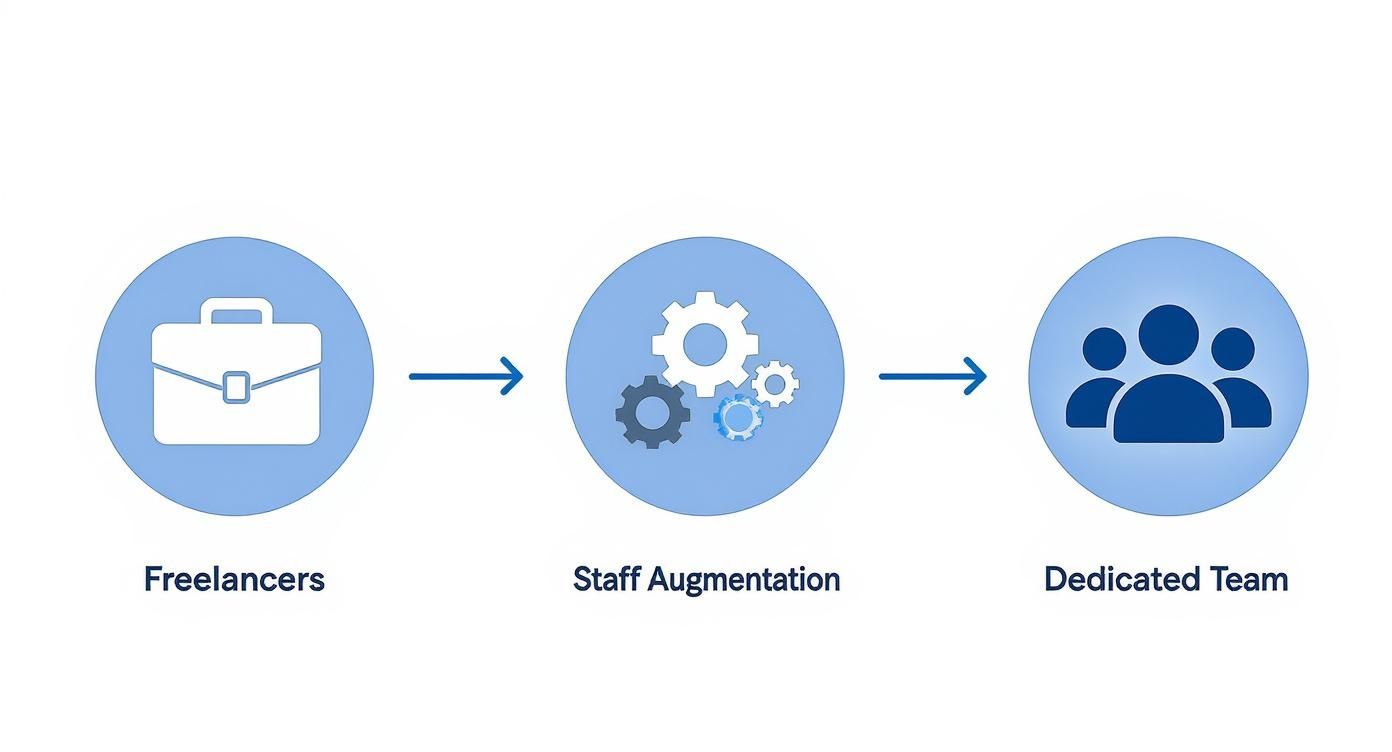
The trend is crystal clear: companies are ditching short-term contracts for long-term, global teams. It’s about stability and making sure institutional knowledge doesn't walk out the door every few months.
Distinguishing Must-Haves from Nice-to-Haves
Once you have a clear vision, it’s time to get ruthless with your skills list. You need two buckets: must-haves and nice-to-haves. This simple act of categorization will make filtering candidates a thousand times easier. I’ve seen so many companies make the mistake of listing every possible technology under the sun, which just scares off highly qualified specialists who think the role is unfocused.
Your must-haves are the absolute dealbreakers. If you're building a high-performance API, deep experience with an asynchronous framework like FastAPI is probably non-negotiable. But familiarity with a different framework, say Django, could be a "nice-to-have"—it shows the developer is adaptable and can learn quickly.
Creating a precise developer profile isn't about exclusion; it's about focus. By clearly defining your core needs, you attract specialists who are genuinely excited by your project's challenges, leading to a much better fit.
Crafting the Role Beyond Technical Skills
A great developer profile goes way beyond a checklist of technologies. In today's remote-first world, soft skills are just as critical, if not more so. Sure, AI can automate some rote coding tasks, but it can't replace a human who can collaborate, communicate, and solve problems with the rest of the team.
Think about these attributes when building out your profile:
Communication Style: Do you need someone who can explain complex technical ideas to your non-tech stakeholders without making their eyes glaze over?
Autonomy Level: Are you looking for a self-starter who can own their tasks from start to finish, or someone who thrives with more direct guidance?
Problem-Solving Approach: Do you need an innovator who loves to experiment, or someone who sticks to proven, battle-tested methods?
This holistic view is what modern staff augmentation is all about. It’s not just about finding globally-sourced talent at a good price; it’s about finding people who have the right technical chops and fit seamlessly into your team's culture and workflow.
How to Source and Vet Top-Tier Python Talent
If you want to hire truly exceptional Python developers, you need to get creative. The best talent isn't just sitting around on LinkedIn waiting for a recruiter to message them. They're deep in the trenches, solving real problems, and you have to meet them where they are.
This means rethinking your entire approach, from where you look to how you evaluate skills. It's about targeting niche communities and using modern vetting techniques that actually reflect the day-to-day challenges of software development.

A huge part of this new strategy is looking globally, not just in your backyard. The salary for a dedicated Python developer can swing wildly depending on their location, and this is something you can use to your advantage.
For instance, a mid-level Python developer with 4-6 years of experience in the United States might command a salary between $100,000 to $120,000. In contrast, a developer with a similar skill set in India might average around $26,200. These numbers aren't just about cost savings; they show how big the global talent pool really is. You can get a more detailed look in this Python developer salary breakdown.
Here's a quick look at how mid-level salaries stack up across a few different countries, giving you a clearer picture of the global market.
Global Python Developer Salary Comparison (Mid-Level)
Country | Average Annual Salary (USD) |
|---|---|
United States | $110,000 |
United Kingdom | $75,000 |
Germany | $70,000 |
Canada | $85,000 |
India | $26,200 |
Poland | $45,000 |
Brazil | $30,000 |
As you can see, the numbers speak for themselves. Tapping into a global workforce gives you access to incredible talent without the sky-high costs associated with major US or Western European tech hubs.
Beyond Standard Job Boards
Like I said, the best Python developers are too busy building to be scrolling through job boards. They're contributing to open-source projects, solving tough problems in specialized forums, and collaborating with their peers.
If you want to tap into this talent pool, shift your focus here:
GitHub and GitLab: Don't just glance at their profiles. Dig into their actual contributions. Look at their pull requests, the quality of their code, and how they interact with others. A developer who actively maintains a popular open-source library is giving you a live demo of their expertise.
Specialized Communities: Platforms like the official Python.org forums or niche subreddits (like r/Python) are goldmines. This is where passionate developers hang out. If you engage authentically, you'll find the hidden gems.
Talent Augmentation Platforms: These aren't your typical staffing agencies. Modern platforms give you access to a pre-vetted, global pool of developers, combining the cost benefits of freelance work with the stability of a dedicated team member.
Vetting for Real-World Problem-Solving
Let's be honest: traditional algorithm quizzes are dead. They test memorization, not the practical, problem-solving skills you actually need to build and ship software. It's time for a vetting process that mirrors what a developer will actually do on your team.
Here's how to design assessments that genuinely test their abilities:
Live Coding Challenges: Forget the whiteboard puzzles. Give them a small, broken piece of code from a real-world app and ask them to debug it with you. This shows you their debugging process, their communication skills, and how they think on their feet.
Take-Home Assignments: A good assignment is a miniature version of a real task. Ask them to build a simple REST API endpoint with FastAPI or scrape data from a sample site using Scrapy. Just be sure to respect their time—keep it to a few hours, max.
The goal of modern vetting is to simulate a day on the job. How does the candidate approach an unfamiliar problem? How do they communicate their thought process? These insights are far more valuable than knowing if they can reverse a binary tree on a whiteboard.
AI-powered screening tools are also becoming a game-changer, especially when you're dealing with a high volume of applicants. These tools can analyze code for quality, flag potential plagiarism, and help you zero in on the most promising candidates right from the start. It's a smarter way to manage your pipeline and focus your energy where it counts.
Alright, let's get past the fluff and talk about what really happens in the interview room. This is where you separate the résumés that look good from the developers who are good.
Once you’ve got a shortlist, it's time to dig in. A solid interview process does more than just check boxes on a technical skills list. It’s your chance to see how a candidate thinks on their feet, how they communicate when they're stuck, and frankly, whether you’d want to work alongside them every day.
Forget the old-school brain-teasers and abstract "what if" questions. They're useless. The best interviews are grounded in reality—your reality. Give them problems that mirror the actual challenges your team is wrestling with right now. This is how you find out if they can actually do the job.
Stop asking tired questions like, "What's your greatest weakness?" It just invites a canned, rehearsed answer.Instead, try something specific that forces them to think: "Tell me about a time you picked a Python library that ended up having some serious limitations. How did you work around it?" A question like that tells you everything—their honesty, their problem-solving chops, and how they adapt when things don't go according to plan.
Going Beyond a Simple Tech Screen
Your technical assessment shouldn’t feel like an exam. It needs to be a conversation, a collaboration. You want to see their thought process in action, especially when they hit a wall. That moment of uncertainty is where you'll learn the most.
I’ve found a multi-step approach works best to get the full picture without burning everyone out:
The Quick Gut Check: Start with a brief technical screen. A quick call to talk about their background, some core Python concepts, and a project they’re proud of. This weeds out anyone who doesn’t have the fundamentals down.
The "Show, Don't Tell" Challenge: Next, a practical coding exercise. This could be a small take-home task or a live pair-programming session. Give them something real, like refactoring a clunky piece of code or spinning up a simple API endpoint. You're simulating a day on the job.
The Big Picture View: For senior roles, you need to know if they can think architecturally. Throw them a system design problem. "Sketch out how you'd build a basic recommendation engine." Listen to the trade-offs they consider and the questions they ask. That’s where their experience shows.
If you’re looking for more inspiration, we put together a list of top technical interview questions for engineers in 2025 that cut through the noise.
Don’t Forget the Human Element
A brilliant coder who can't work with others is a net negative for the team. This is even more true in a remote setup where clear communication is everything. You have to actively screen for soft skills like collaboration, resilience, and accountability.
Behavioral questions are your best tool here. Frame them around past experiences.
"Walk me through a time you and a teammate had a major disagreement on a technical decision. How did you resolve it?"
"Describe a project where the goalposts kept moving. How did you stay on track and manage the chaos?"
Questions like these open a window into how they handle conflict and uncertainty. You're not just hiring a pair of hands to write code; you're looking for a genuine team player who will make the whole organization stronger. That’s how you build a dedicated global team that lasts.
Onboarding and Retaining Your Dedicated Developer
Getting the contract signed isn't the finish line; it’s the starting gun. When you hire a dedicated Python developer, the real work of turning that new hire into a high-impact, long-term team member is just beginning. A clunky, disorganized onboarding can kill a developer's excitement before they even write a line of code. A smooth one makes them feel valued and ready to jump in.
The goal here is simple: eliminate friction so they can start solving real problems, fast. A thoughtful integration process sets the tone for the entire relationship, especially when you're working with a global, remote-first team.

Building a 30-60-90 Day Onboarding Plan
A structured plan is your best friend for a seamless integration. It provides clarity and direction, helping your new developer understand exactly what’s expected of them and what milestones they need to hit. The 30-60-90 day framework is a proven model that breaks this ramp-up period into manageable chunks. To keep the entire process—from offer to offboarding—running smoothly, it's also worth exploring some contract lifecycle management best practices.
Here’s a practical way to break it down:
First 30 Days (Integration): This is all about setup and learning. Get their dev environment configured, grant access to all the tools, and introduce them to the key people they'll be working with. Their first task should be something small and low-risk—a tiny bug fix or a documentation update—just to get them comfortable with the codebase and your workflow.
Next 30 Days (Contribution): Time to start taking on more ownership. Assign them a small feature or a well-defined set of bugs. This phase is perfect for regular check-ins and pairing sessions to build collaborative habits and reinforce what they’ve learned.
Final 30 Days (Autonomy): By now, your developer should be operating more independently. They should feel confident contributing to sprint planning, participating in code reviews, and picking up tasks on their own. The goal is to see them transition from a learner to a fully autonomous member of the team.
A great onboarding process is about more than just tasks and tools; it’s about connection. Assigning a buddy or mentor can be a game-changer. It gives the new hire a go-to person for those small questions they might feel hesitant to ask the entire team. For a deeper dive, check out our modern guide on how to onboard remote employees.
Fostering Long-Term Loyalty and Growth
Onboarding has an endpoint, but retention is an ongoing effort. The secret to keeping top talent isn't complicated: create an environment where they feel challenged, supported, and genuinely valued. This is absolutely critical in a market where skilled developers have endless options.
One of the most powerful retention tools you have is investing in your developer’s growth. It shows you see them as a long-term asset, not just a temporary fix.
Here’s what that looks like in practice:
Personalized Development Paths: Sit down with them and figure out what they want to learn next. Is it mastering a new AI library? Or maybe developing leadership skills? Create a path to get them there.
Transparent Communication: Keep the channels for feedback wide open. Regular, honest conversations about performance, roadblocks, and career goals build the kind of trust that keeps people around.
Competitive Compensation: The market for Python developers is always moving. You need to benchmark salaries and benefits regularly to stay competitive. Experience drives value, and top-tier senior developers can command salaries over $185,000 in some markets, reflecting their advanced skills and impact.
Navigating Global Hiring Models and Costs
Choosing how you hire dedicated Python developers is a huge financial decision, and it goes way deeper than just salary. The path you take—direct hiring, sifting through freelance platforms, or embracing a modern staff augmentation model—will shape your budget, your team's administrative load, and the long-term stability of your entire project.
Let's be real: traditional direct hiring is loaded with hidden costs. You're not just paying a salary. You're on the hook for hefty recruitment fees, benefits packages, payroll taxes, and all the office overhead that comes with it. This model gives you total control, sure, but it also comes with the highest total cost of ownership. For startups and mid-size companies trying to scale without breaking the bank, it’s a tough route.
Freelance platforms seem cheaper upfront, but they trade cost for chaos. They're great for one-off tasks or short-term gigs, but building your core product on a revolving door of freelancers is a recipe for disaster. All that crucial institutional knowledge just walks out the door when a contract ends. That kind of churn kills momentum and grinds innovation to a halt.
The Modern Staff Augmentation Approach
There’s a smarter way to tap into global talent that's gaining traction: a new kind of staff augmentation. This model gives you the best of both worlds—the affordability of a global workforce combined with the loyalty and deep integration of a full-time employee. You get a dedicated developer who is 100% committed to your team and your vision, but without the crippling overhead of a direct hire.
This approach is built on a simple truth: talent is everywhere, and advancements in technology have made borders meaningless. When you partner with a specialized service, you get to skip all the headaches of international compliance, payroll, and legal red tape. You can just focus on what you do best: building incredible software.
This isn't just another flavor of outsourcing; it's strategic team building. You're not just hiring a coder; you're gaining a dedicated, long-term partner who will understand your business inside and out. That's how you build a stable, knowledgeable engineering team that consistently ships great work.
Understanding the True Cost of Global Talent
The financial upside of hiring globally is undeniable. The market for Python talent is incredibly diverse, with salaries varying massively from one region to another. For instance, while a skilled Python developer might command between $78,000 and $105,000 a year in Western markets, you can find equally brilliant talent in emerging tech hubs for a fraction of that cost. You can dive into a full breakdown of Python developer salary data from around the world to see the numbers for yourself.
This cost arbitrage is a game-changer. It allows startups and SMEs to finally compete with the big guys for world-class engineering talent. Our practical guide to hiring international employees breaks down exactly how to navigate these global markets and find those hidden gems.
By shifting to a modern staff augmentation model, you can bring on dedicated Python developers who are both top-tier and affordable. It's a forward-thinking strategy that aligns your budget with your biggest growth ambitions, ensuring you get the absolute best return on your talent investment.
Got Questions About Hiring Python Developers?
You're not alone. When you're looking to hire dedicated Python developers, a few key questions always seem to pop up. Getting straight answers is the only way to feel confident you're making the right move for your company. Let's cut through the noise and tackle them head-on.
What’s the Real Difference Between a Dedicated Developer and a Freelancer?
This is a big one. Think of a dedicated developer as a core, long-term member of your team who just happens to work remotely. They’re 100% focused on your projects, immersed in your company culture, and invested in your success. It’s a modern way to build a stable, knowledgeable team without the geographical limitations of a traditional hire.
A freelancer, on the other hand, is classic contingent labor. They're typically brought in for short-term, specific tasks and often balance your project with several other clients. That’s great for a one-off job, but it rarely builds the deep-seated ownership you need for complex, ongoing software development.
A dedicated developer isn't just a pair of hands you rent; they're a strategic partner. This model gives you the loyalty and focus of an in-house employee but with the flexibility and cost benefits of a global talent pool.
How Long Is This Really Going to Take?
The honest answer? It can take anywhere from two to eight weeks. The timeline really depends on how specific your needs are and how you're sourcing candidates. If you're going the old-school recruiting route, expect a long, manual slog.
But that's not the only game in town anymore. Tech-enabled talent platforms are completely changing how fast you can hire. By using things like AI-powered vetting and tapping into pre-screened global talent pools, these platforms can shrink that timeline down to just a couple of weeks. They do the heavy lifting of initial screening so you don't have to.
What Soft Skills Actually Matter for a Remote Python Developer?
Technical chops are a given, but for a remote developer, soft skills are what separate the good from the great. When someone isn't sitting in the office next to you, their ability to communicate and manage themselves becomes absolutely critical.
Here’s what I look for, no exceptions:
Proactive Communication: They don't wait for you to ask for an update. A great remote dev is constantly sharing progress, flagging potential issues, and clearly explaining what they're working on, even across different time zones.
Serious Self-Discipline: You can’t be a micromanager. The best remote developers own their schedules, hit their deadlines, and get the work done without someone looking over their shoulder.
A Problem-Solving Mindset: When they hit a wall, they don’t just stop and wait for instructions. They’re already researching solutions, trying out different approaches, and coming to you with potential answers. That's real ownership.
Ready to build your team with elite, affordable global talent? At Shorepod, we connect you with pre-vetted, dedicated Python developers who will become a core part of your success. Find your perfect developer at https://www.shorepod.com.
Comments