Drafting the Perfect Terminating Services Letter
- Ron Smith

- Oct 27
- 12 min read
Ending a professional relationship is never easy. But doing it without a terminating services letter is asking for trouble. This simple document is your formal, official, and legally sound way to end a service agreement. It protects your business by spelling out the final terms and, more importantly, keeps future disputes from ever happening.
Why You Can't Afford to Skip the Termination Letter
Let's be clear: ending a professional relationship—whether with a full-time employee or a freelance contractor halfway across the world—is a delicate dance. In today's dynamic workforce, which increasingly relies on contingent labor and global talent, a well-written terminating services letter isn't just a good idea; it's your most critical tool for risk management. Think of it as both a formal notice and a legal shield.
The whole point of the letter is to kill ambiguity. It creates a clear, black-and-white record of the decision, the final date, and what happens next. That clarity is the secret to a smooth offboarding process where everyone knows exactly where they stand.
Setting the Tone for a Professional Goodbye
You might need to send one of these letters for all sorts of reasons. Maybe a contract is just naturally coming to an end. Or maybe it's something more sensitive, like a performance issue or a major shift in your business strategy. Whatever the reason, the letter makes the separation professional and official.
This is especially true as workforce management trends evolve. Companies are juggling a mix of in-house teams, temporary help, and specialized global talent sourced through advanced staff augmentation models. Having a standard, formal process for ending these arrangements is the only way to ensure you're being consistent and fair to everyone.
A termination of services letter is the formal, written notice used globally to end business, employment, or service agreements. It's not just a formality—it serves a real legal and administrative purpose by clarifying the terms to prevent misunderstandings and messy legal fights. You can learn more about the legal side of things at Postgrid.com.
Dodging Risks in a Global Workforce
Hiring remote and global talent has opened up a world of possibilities, but it also brings a whole new layer of compliance headaches. A clear termination letter is your paper trail. It’s proof that you followed a formal process and communicated the terms directly, which can be a lifesaver if a dispute ever pops up.
For businesses leveraging a new kind of staff augmentation to find affordable global talent, building automated (but still customizable) termination letter templates is a no-brainer. This move ensures you're legally consistent across different countries while saving a ton of admin time. It’s a perfect example of how a simple document, supercharged with a little tech, becomes essential for managing the entire lifecycle of your contingent labor—from hello to goodbye.
Anatomy of a Legally Sound Termination Letter
Let's move past the guesswork. A terminating services letter isn't just a formality; it's a legal document that needs to be clear, comprehensive, and defensible. Think of it as a final blueprint for the professional relationship. Every single component has a purpose, from protecting your company from future headaches to giving the departing individual the clarity they deserve.
Getting these details right is what turns a genuinely uncomfortable task into a manageable, standardized process.
This isn't just about ticking boxes. The goal is to formalize the separation in a way that protects your organization from potential disputes down the road.
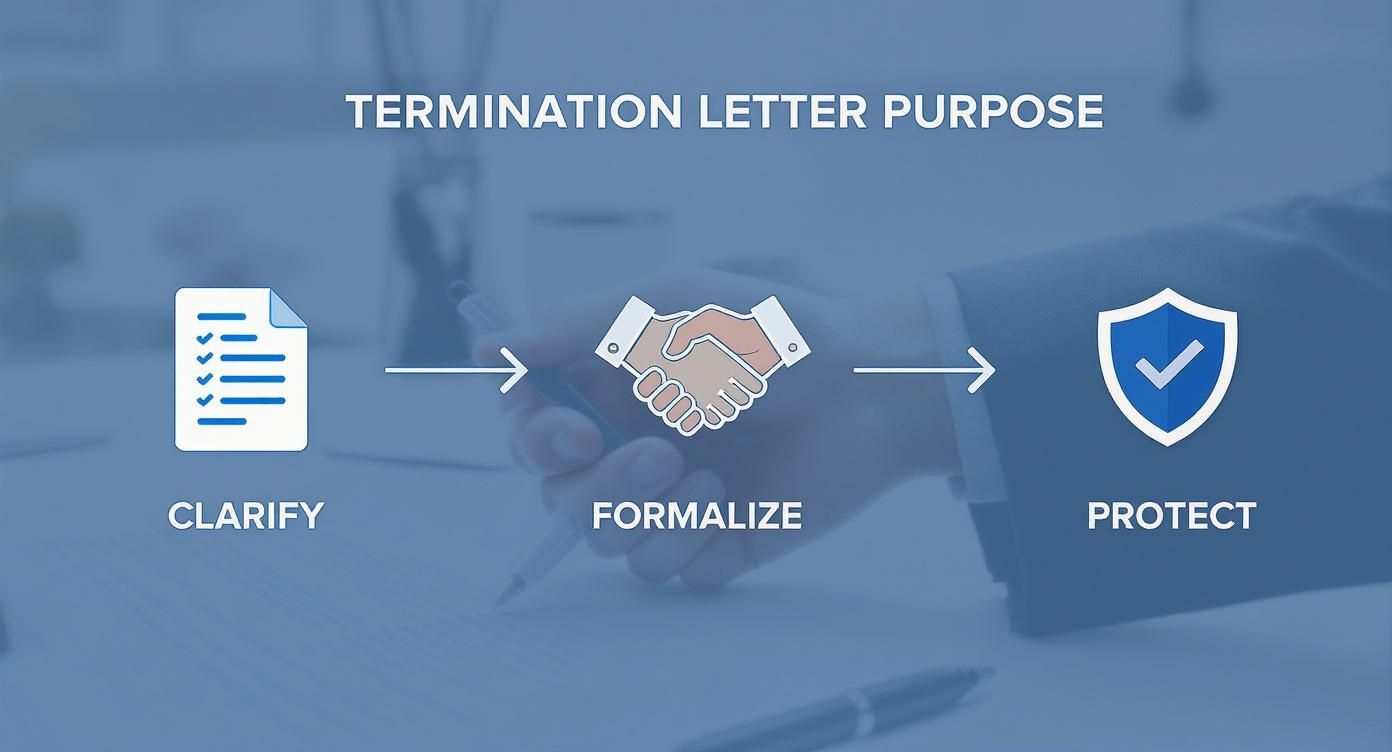
As you can see, each step logically builds on the last. It’s a workflow designed for professional precision and legal foresight, leaving absolutely no room for the kind of ambiguity that fuels future conflicts.
The Non-Negotiable Components of Your Letter
Certain elements are simply not optional. Including them ensures you've met your obligations and provided all the necessary information, creating a clean break for everyone involved.
Every termination letter I've ever reviewed—or written—hinges on a few core components. Getting these right is the first step to a legally sound document.
Here’s a breakdown of what you absolutely must include, why it matters, and a tip from my own experience.
Key Components of a Termination Letter
Component | Purpose | Pro-Tip |
|---|---|---|
Direct Statement of Termination | Leaves no room for misinterpretation. It officially and clearly states the purpose of the communication. | Don't soften the language too much. Be direct but professional. A simple, "This letter confirms the termination of your service agreement," is perfect. |
The Effective Date | Establishes the exact final day of service, which is critical for payroll, benefits, and system access. | Always spell out the full date (e.g., "October 31, 2024") to avoid any confusion between different date formats. |
Final Payment Details | Outlines all compensation owed, preventing future claims of unpaid wages or benefits. This is a common source of legal trouble. | Be hyper-specific. List each payment type (final wages, accrued vacation, etc.), the amount, and the date and method of payment. |
Return of Company Property | Creates a clear, documented process for retrieving company assets, protecting your physical and intellectual property. | Include a specific deadline and provide clear instructions. If they need to ship items, state who pays for postage and provide a shipping label if possible. |
Reminder of Ongoing Obligations | Reinforces legally binding agreements like NDAs or non-compete clauses that survive the termination. | Keep the tone neutral. A simple reminder like, "Please remember your obligations under the Confidentiality Agreement..." is all you need. It’s a reminder, not an accusation. |
These core sections form the backbone of your letter. Once they're in place, you can add any details specific to your company's offboarding process or any other contractual loose ends that need tying up.
Nailing the Practical Details
After you've covered the big legal stuff, the letter needs to handle the logistics of the separation. This is where you outline the "what next" for returning property and remind them of any ongoing obligations. A clear process here prevents those annoying loose ends that can snowball into bigger problems.
A well-crafted letter doesn't just end a contract; it closes the professional relationship on clear, respectful, and legally sound terms. The goal is to provide a final, official record that answers all practical questions before they're asked.
Be specific about company property—laptops, key cards, phones. Give them a hard deadline and explain the process. Will they be shipping the equipment back, or do they need to drop it off at the office? Don't make them guess.
Finally, you'll want to gently touch on any binding agreements that continue after they're gone, like confidentiality or non-compete clauses. You don't need to be heavy-handed. A simple sentence like, "As a reminder, your obligations under the Confidentiality Agreement signed on [Date] remain in effect," is usually all it takes. This reinforces their duties without sounding accusatory and helps ensure a clean, professional closure.
Dodging Legal and Compliance Landmines
A poorly handled terminating services letter isn't just awkward—it's a legal grenade waiting to go off. Get it wrong, and you’re looking at a world of expensive, time-consuming trouble. In today’s world of global teams and contingent labor, one wrong move can open your company up to some serious risk.
The words you choose are everything. Using vague, emotional, or speculative language is practically an invitation for a legal challenge. You have to stick to the facts—objective, documented reasons tied directly back to the service agreement or specific performance metrics. Stay away from subjective statements like "not a good fit." That kind of ambiguity is a magnet for misinterpretation and can easily be twisted into a claim of discrimination.

This is a huge deal in high-turnover industries where you need fair, standardized processes to protect yourself. Think about it: documented cases show that badly written (or nonexistent) termination letters are a factor in roughly 30% of wrongful dismissal lawsuits.
And in sectors like customer service, where annual turnover can soar past 40%, a professional and legally sound termination process isn't just good practice—it's essential for survival.
Pay Attention to Contractual and Legal Timelines
Ignoring the notice period is one of the easiest and most costly mistakes you can make. Your service agreement is your roadmap here. If that contract says a 30-day notice is required, your letter needs to reflect that, down to the exact day.
Mess this up, and you could be facing a breach of contract claim, forcing you to pay for that notice period whether the work was done or not. It gets even trickier with an international team of contingent labor. Local labor laws often have their own minimum notice periods that can—and will—override whatever your contract says.
To make sure your letter is airtight, get familiar with regulations like the Employment Standards Act termination guidelines in Ontario and similar laws in any other region where you have people.
Why You Can't Skip Legal Counsel
Thinking of a legal review as a last-minute checkbox is a high-stakes gamble. An attorney is trained to spot liabilities that an HR manager or team lead might completely miss. They’ll make sure your language is defensible and that you’re not violating any regulations. This is non-negotiable, especially when you’re managing global talent who fall under entirely different legal systems.
Consulting a lawyer isn't just a friendly suggestion; it's a core part of risk management. It’s what shields your organization from wrongful termination claims and protects your company's reputation.
A thorough legal review is absolutely critical if you're using a new kind of staff augmentation model to source the most affordable global talent. With a workforce from all over the world, you're navigating a complex web of international labor laws. A standardized, legally-vetted process is the only way to ensure you’re consistent and compliant.
For a more detailed breakdown, our https://www.shorepod.com/post/employee-termination-process-checklist-5-essential-steps is a great resource to follow.
In the end, taking a proactive, legally-informed approach is what turns your terminating services letter from a potential liability into a tool that actively protects your business.
Real-World Termination Letter Templates
Generic templates often read too broadly. A terminating services letter for a solo freelancer demands a different tone than one for a B2B partner. Here, you’ll find ready-made examples you can tweak for your own scenario.
Each sample comes with notes on why certain lines work and where you’ll swap in your own details. That way, you strike a firm yet respectful tone—keeping things professional and cutting down on friction.

Freelance Contractor Termination Letter Example
Navigating the end of a freelancer relationship means being crystal clear. This sample letter is built for contract workers, regardless of where they’re based.
Subject: Notice of Termination of Service Agreement
Dear [Freelancer Name],
This letter is formal notice that we will end our service agreement on [Termination Date].
Why it works: Leading with the purpose keeps things unambiguous.
We’re making a strategic pivot in our project roadmap, not commenting on your performance.
Why it works: A neutral business reason helps protect goodwill.
We’ll settle all invoices up to [Termination Date] by [Final Payment Date]. Please send your final invoice by [Invoice Submission Deadline].
Why it works: Specific dates remove confusion over payments.
Return the company laptop (Serial #12345) with the prepaid label you’ll receive by [Date].
Why it works: Exact instructions speed up asset returns.
Thanks for your efforts. Wishing you success in your next venture.
Sincerely,[Your Name][Your Title]
B2B Service Agreement Termination Letter Example
Shutting down a contract with another business means focusing on the fine print and a smooth handoff.
Subject: Formal Notice to Terminate Service Agreement **#[Contract Number]**
Dear [Vendor Contact Name],
Please accept this as formal notice that [Your Company Name] is terminating service agreement #[Contract Number], effective [Termination Date], per the [Number]-day notice period in our contract.
Why it works: Citing the contract term shows you’re honoring the agreed timeline.
We plan to bring these services in-house to support our revamped operations. We’ll collaborate on final deliverables and secure data transfer by the termination date.
Why it works: Framing it as teamwork reduces tension.
All outstanding payments will be settled under our agreed terms.
Thank you for your service.
Regards,[Your Name][Your Title]
These templates give you a solid starting point, but real-world teams change fast. If you’re managing a distributed staff, you’ll need to tweak these letters to match local rules and cultural norms. Our guide on creating a remote work policy template for modern teams dives deeper into that process.
Modern tools can simplify sensitive communications. For a smoother process and faster templates, explore AI for Termination & Relieving Letters. These resources keep your letters consistent, compliant, and ready for global staff-augmentation models.
The Future of Workforce Offboarding
Let's be honest, the way we handle workforce transitions is changing, and fast. The days of digging up generic templates for a terminating services letter are over. That old-school, manual approach is a relic, and it’s being replaced by smarter, tech-driven solutions. For any company managing a diverse, global team of contingent labor, this isn't just a "nice-to-have"—it's a necessity.
Emerging trends in workforce management point directly toward automation and AI-powered tools. Modern HR platforms are leading this charge, turning offboarding from a reactive, paper-pushing headache into a proactive, strategic part of the talent lifecycle. These systems can now generate legally-vetted termination letter drafts customized for specific regions and their unique compliance rules, an essential feature for managing global teams.
AI in Offboarding and Staff Augmentation
This technological shift is a game-changer, especially for businesses using staff augmentation to build global teams at an affordable cost. When your talent is sourced from around the world, you can't afford to get offboarding wrong. Consistency and compliance are everything. A single misstep can expose you to some serious legal and financial heat.
This is where advancements in AI really step up to mitigate those risks. It’s not just about speed; it's about being smart.
Automating Compliance Checks: Imagine a system that automatically ensures every letter and procedure is in line with local labor laws, whether you're offboarding a contractor in the Philippines or an engineer in Poland. AI makes this possible.
Streamlining Asset Recovery: AI can trigger automated workflows to track and get back company property. Laptops, keycards, software licenses—it’s all logged and managed without someone having to chase it down manually.
Ensuring Consistency: It guarantees you're using a standardized, fair process for every contingent worker, no matter where they are. This removes bias and protects the company.
This tech-forward approach does more than just make things efficient. It protects your employer brand. A smooth, professional, and respectful offboarding process leaves a positive final impression, and in a world where professional reputations are built (and destroyed) online, that’s huge.
Building a Forward-Thinking Offboarding Strategy
A modern offboarding strategy isn't an afterthought; it's a core piece of your overall contingent labor management plan. By leveraging AI to automate the tricky, administrative parts of a separation, you free up your HR team to focus on what matters most: the human element. They can ensure a dignified and supportive exit for the individual.
The goal is simple: create an offboarding experience that's just as seamless and professional as your onboarding. This protects the company, shows respect to the person leaving, and maintains the integrity of your entire global workforce strategy.
Bringing these new technologies into your workflow helps you manage a flexible, contingent workforce more effectively and affordably. As you work on refining your own process, it’s smart to keep an eye on the bigger picture. You can get some great ideas by checking out the 7 workforce planning best practices for 2025 to make sure your strategy is built for what's next.
Common Questions About Termination Letters
Ending a professional relationship is never easy, and getting the terminating services letter right can feel like walking a tightrope. Let's tackle some of the most common questions that come up when you’re navigating this process.
Should I State the Reason for Termination?
This is one of the trickiest parts, and the answer isn't always straightforward. It really boils down to your company policy, the specifics of the situation, and, frankly, what your lawyer says.
For "at-will" employment, you're often not legally required to give a reason. In fact, doing so can sometimes open you up to risk if the reason isn't perfectly documented and bulletproof.
But if you're terminating "for cause" or ending a formal contract, providing a clear, factual, and non-dramatic reason is usually the way to go. The golden rule? Always run it by legal counsel to figure out the safest path for your specific circumstances.
What Is the Ideal Notice Period?
Your first stop for this answer should always be the signed contract or service agreement. If the contract doesn't specify a notice period, your next step is to check local and national labor laws, which often have minimum requirements.
Giving more notice than required can be a nice gesture, but it’s not always practical. Your absolute priority is to be 100% compliant with every contractual and legal obligation. Don't guess here.
How Should I Deliver the Termination Letter?
The best practice is still face-to-face. Delivering the letter in person during a private meeting allows for a real conversation, helps you answer any immediate questions, and shows a level of respect for the individual. It's just the right thing to do.
After that meeting, immediately send a copy using a trackable method. A secure email with a delivery receipt or even certified mail creates a formal paper trail, giving you documented proof that the notice was officially received.
Can a Termination Letter Be Sent Via Email?
Absolutely. It's becoming more and more common, especially with remote employees and global contingent labor. The most important part isn't the method; it's ensuring you have undeniable proof they received it.
Here are a few ways to handle that:
Use an email tracker with a read receipt.
Ask the recipient to reply with a simple confirmation.
For really sensitive situations, a certified email service can provide extra legal backing.
But here’s the key: an email should never be the first they hear of it. Whenever possible, it should follow a conversation—whether that’s a phone call or a video meeting. That combination of a personal touch and formal documentation is the modern standard for handling offboarding professionally and compliantly.
At Shorepod, we get how complex it is to manage a global workforce, from the first day to the last. We offer a new kind of staff augmentation, providing access to world-class, affordable global talent while handling the tricky details of international compliance and payroll. Find a smarter way to build your team at https://www.shorepod.com.
Comments